
REVIEW · HUE IMPERIAL CITY AND ROYAL TOMBS
Hue Imperial City and Forbidden City Walking Private Tour
Walls with stories, and a guide who explains them. This private walking tour turns the Hue Citadel into a clear Nguyen Dynasty story across 143 years, so you know what you are looking at and why it mattered. I especially like the dynastic-history storytelling that connects gates, palaces, and daily court rituals to names you will actually remember.
I also like the smart, low-stress flow. You meet at the Four Bronze Cannons area near Ngan Gate with an A4 paper showing your name, and the guide helps you with entry tickets so you do not waste time guessing where to go next. The pacing stays walkable, with short photo stops and guided time at each highlight, built for a 150-minute visit.
One possible drawback is that the Imperial City entrance ticket is not included. Plan on paying 200,000 VND per adult on the day, and bring cash VND since the guide will help you purchase tickets and keep the line moving.
In This Review
- Key highlights worth your time
- Enter Hue Imperial City with a 150-minute private guide
- Meeting at Cửa Ngăn and ticket help that saves real time
- Flag Tower to Cua Ngo Mon: start with power and access
- Thai Hòa Palace and the Forbidden Purple City mindset
- Duyệt Thị Đường Royal Theater: ritual you can see
- Thiệu Phương Garden and Thái Bình Lầu: the calmer side of power
- Kien Trung Palace rebuilt in 2024, and why it matters
- Cung Diên Thọ and Hưng Tổ Miếu: family, legacy, and worship
- Nine Dynastic Urns and Hien Lâm Các: Minh Mạng to epiphanies
- Finish at Cửa Hiển Nhơn, then use your leftover time well
- Price and logistics: what $23 really buys
- Who should book this Hue Imperial City and Forbidden City tour
- Book it or skip it
- FAQ
- What is the duration of the Hue Imperial City and Forbidden City walking private tour?
- Where do I meet the tour guide?
- Is the Imperial City entrance ticket included in the price?
- How much is the Imperial City entrance ticket?
- Are there combo ticket options if I want tombs too?
- What does the tour include?
- What language is the tour guide?
- Is this a private tour?
- Where does the tour finish?
- What is the cancellation policy?
Key highlights worth your time
- Start at the Bronze Cannons near Cửa Ngăn so you begin inside the story, not outside it
- English guidance built around Nguyễn court life, not just facts on a sign
- Thai Hòa Palace and the Forbidden Purple City rules give context for who could go where
- Duyệt Thị Đường Royal Theater is the oldest preserved theater from the Nguyen Dynasty
- Kien Trung Palace restored in 2024 shows how Hue handles loss, rebuilding, and change
- Nine Dynastic Urns commissioned by Emperor Minh Mang give you a striking visual timeline
More of the citadel and the tombs along the river
- Hue Customizable Tour with Imperial Citadel & Forbidden City★ 4.9 · 937 reviews
- Hue :Exploring Royal City with Multi Options and Dragon Boat★ 5.0 · 675 reviews
- Hue City Tour Full Day – Group Tour★ 4.7 · 518 reviews
- From Hue: DMZ Tour with Vinh Moc Tunnels and Khe Sanh Base★ 4.9 · 503 reviews
Enter Hue Imperial City with a 150-minute private guide
Hue can feel like a maze if you wander on your own. This tour is designed to make sense of the layout fast, with an English-speaking guide and a private group format. The timing is tight in a good way, about 150 minutes, which means you get meaningful coverage without spending the whole day in line and backtracking.
I like that the tour is not just sightseeing. The guide is there to connect the space to the Nguyen Dynasty’s long reign, so details start to click: gates are not random. Each one signals ceremony, hierarchy, and access rules.
You will be walking through the core imperial areas, with planned photo stops and short guided segments. That structure helps if your attention span is more street-smart than museum-dossier, which is usually the case when you are on a real trip.
Meeting at Cửa Ngăn and ticket help that saves real time
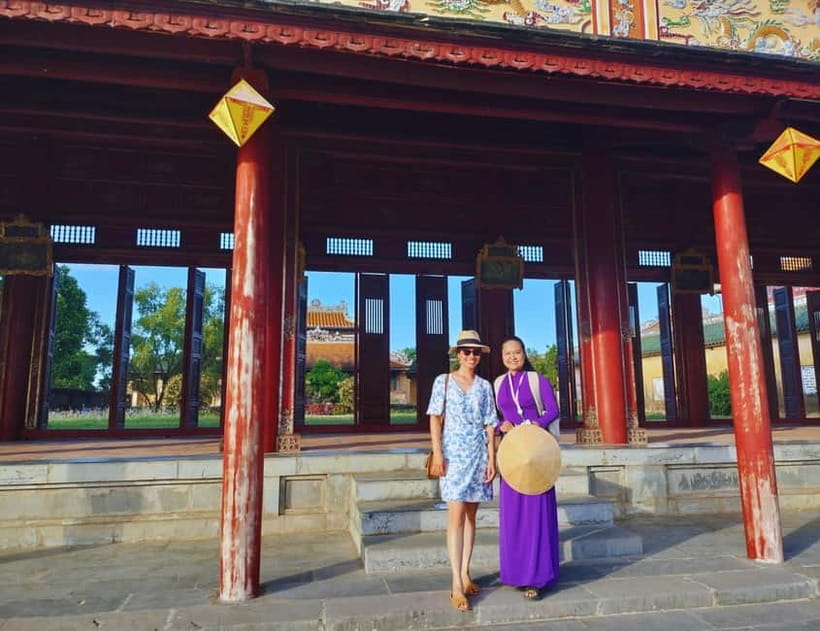
Your guide meets you at the 4 Bronze Cannons area near Ngan Gate (Cửa Ngăn), with an A4 paper displaying your name. This matters more than it sounds. The Hue Citadel area has lots of entry points, and a clear meeting spot lowers the stress immediately.
Ticket planning is also handled on the ground. Entrance ticket for the Imperial City is 200,000 VND per person, and the guide will assist you with buying it. You can queue less if you prepare cash VND ahead of time, so you are not stuck searching for an ATM while everyone else is moving.
If you already know you will visit tombs too, consider the combo options the guide can help with: 420,000 VND for the Imperial City plus 2 tombs, or 530,000 VND for the Imperial City plus 3 tombs (valid for 2 days). Even if you do not use the combos, it is useful information so you do not pay twice in a day or two.
Flag Tower to Cua Ngo Mon: start with power and access
The first stop is the Flag Tower (Kỳ Đài Huế). This is not just a tall landmark. In Nguyen architecture, it served as the flag-bearing site for the royal court. Your guide’s job here is to translate the visual design into meaning, so the tower becomes part of court procedure, not only a photo target.
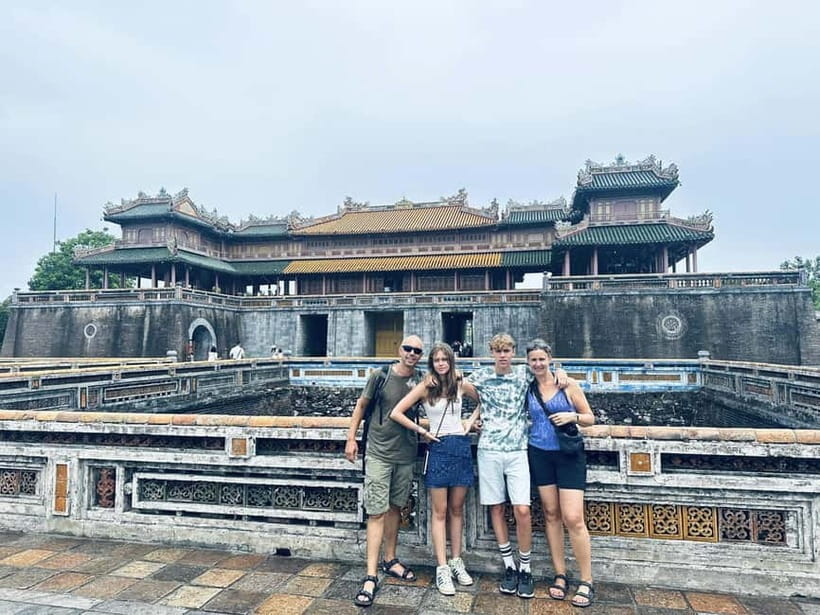
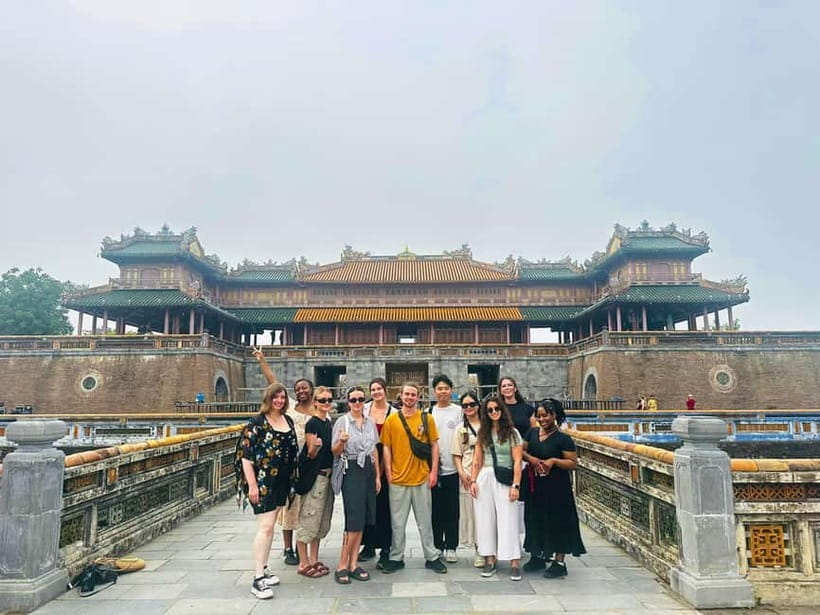
Next you head to Cua Ngo Mon (Hue), with a short walk and guided explanation. This is where the tour’s “why it matters” approach pays off. You start learning how each gate fits into movement rules, ceremonial arrivals, and the idea that the city was built to control access.
If you enjoy history that feels like it has operating instructions, this is your moment. Gates and walls are easier to understand when you know who was allowed through and what the gate was for.
Thai Hòa Palace and the Forbidden Purple City mindset
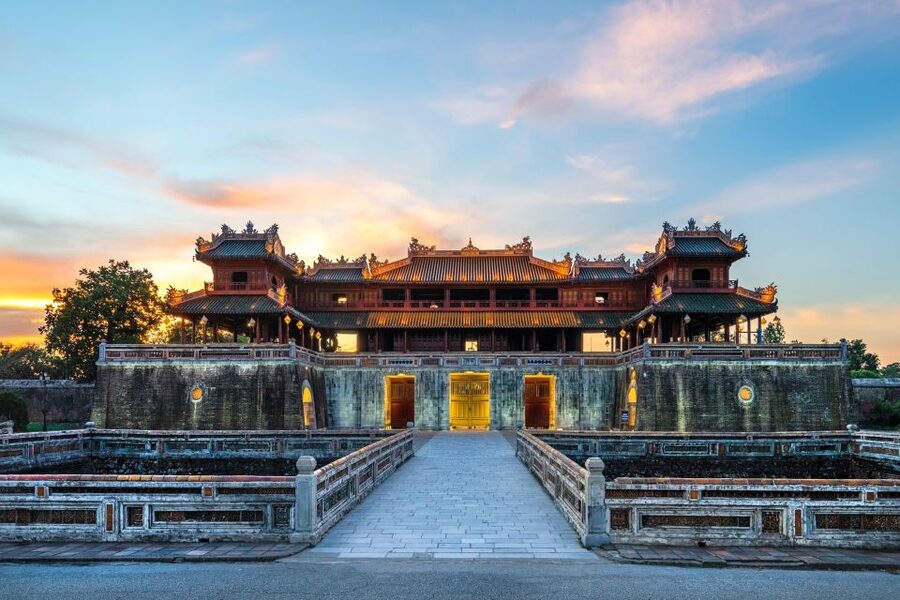
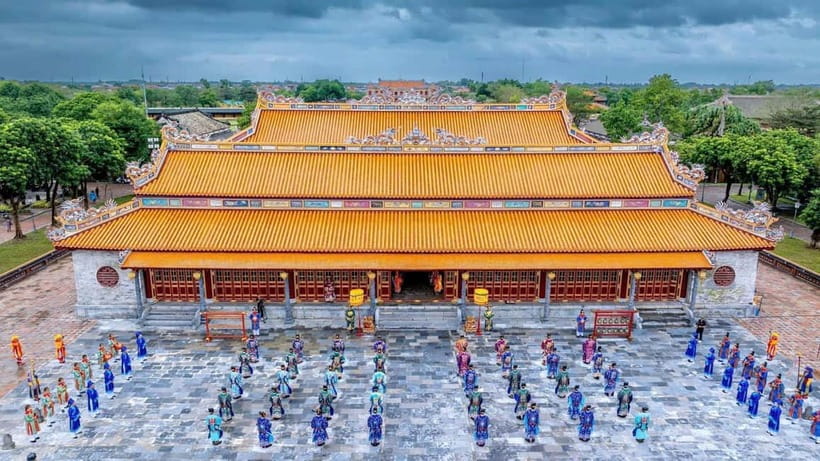
At Thai Hòa Palace (Điện Thái Hòa), the guide focuses on coronations. Thai Hoa is the coronation place of 13 Nguyen kings, inside the Imperial Citadel area of Hue Citadel. When you stand there, it helps to understand that this was a stage for political legitimacy, not a scenic backdrop.
Then comes the big concept: the Forbidden Purple City (Tử Cấm Thành). The idea is clear in the tour explanation, that it was reserved for the king and royal family, while mandarins and civilians were not allowed close. Even if you cannot treat it like a walk-in attraction, this context changes the way you view the surrounding layout.
This is one reason I think a guided visit is worth it. Without context, the forbidden areas can feel like vague background. With context, you understand the social design of the place.

Duyệt Thị Đường Royal Theater: ritual you can see
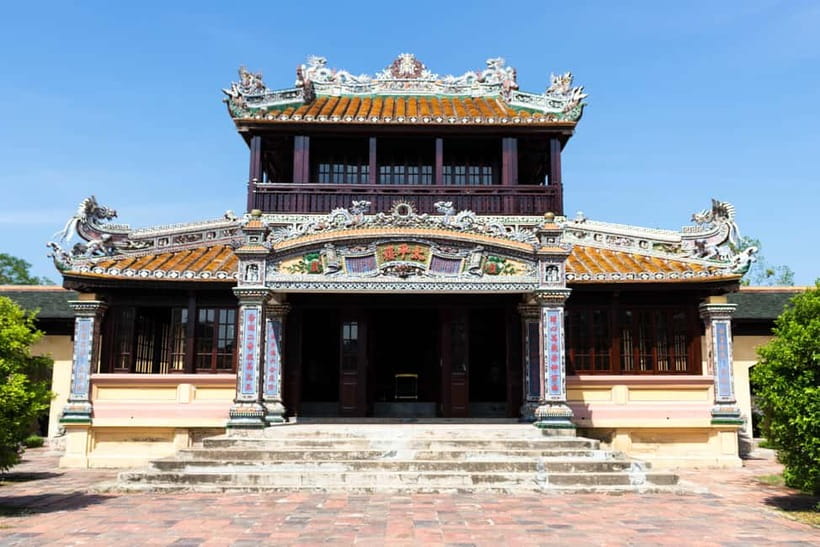
The tour includes Duyệt Thị Đường (Duyet Thi Duong) Royal Theater, one of four theaters built during the Nguyen Dynasty. It is also described as the oldest preserved theater. That makes the stop more than a cultural sidelight.
The theater is where the imperial world shows up in performance. Even if you are not watching a show, the space helps you understand that ceremonies involved not just officials and architecture, but scripted public behavior, music, and pageantry.
This is a good stop if you like the human side of history. Thrones and gates can feel distant. A theater makes court life feel staged and intentional.
Thiệu Phương Garden and Thái Bình Lầu: the calmer side of power
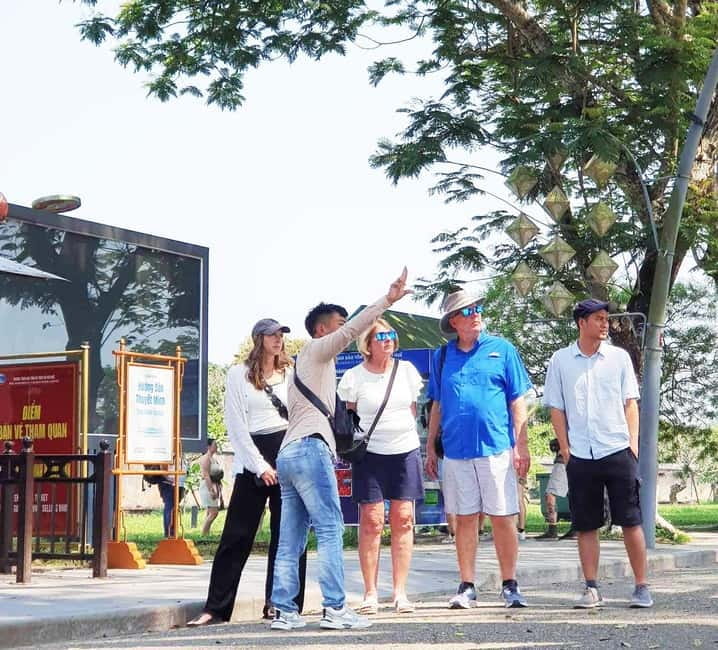
Not everything in Hue is about formal ceremony. The tour balances structure with softer spaces through two major leisure stops.
First is Thiệu Phương Garden (Vườn Thiệu Phương), built in 1828. It is one of the typical royal gardens of the Nguyen Dynasty. When you walk there with a guide, you start noticing how garden design works as a controlled retreat, built for royal enjoyment while still reflecting status.
Then comes Thai Binh Pavilion (Thái Bình Lâu), built from 1919 to 1921. It was a place for the king to rest and relax. I like that this stop shows the timeline shifting into later Nguyen-era preferences, rather than treating the empire as a single frozen moment.
If your brain gets tired of “name, date, next gate,” these two breaks help reset your attention. You still learn, but in a more grounded way.
Kien Trung Palace rebuilt in 2024, and why it matters
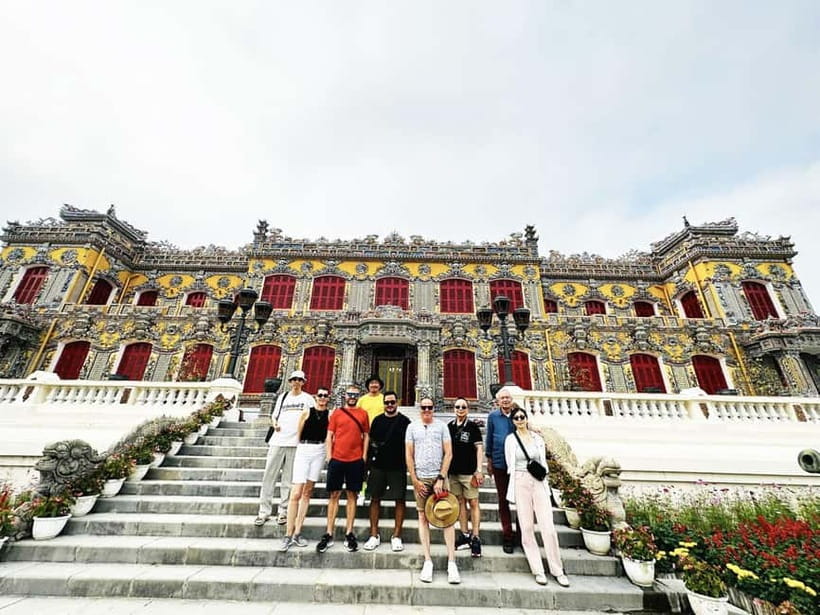
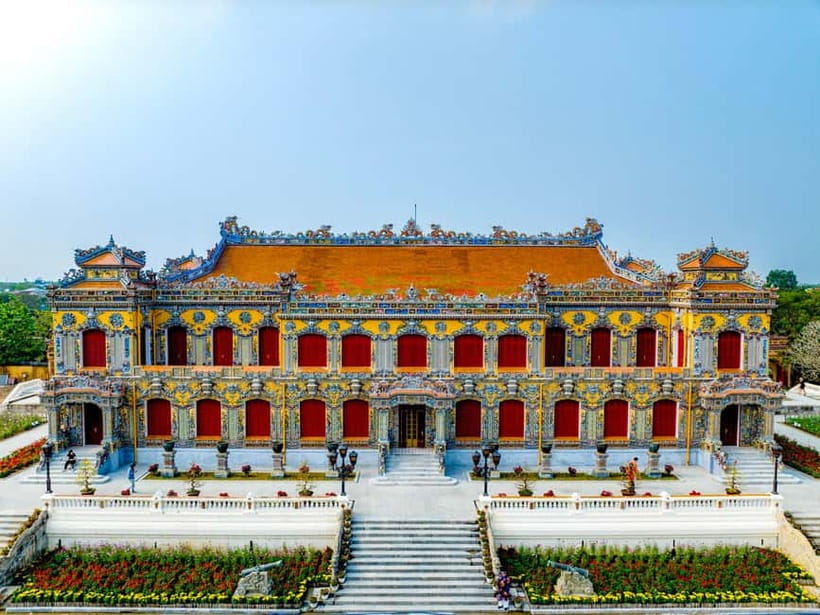
One of the most memorable stops is Kien Trung Palace (Điện Kiến Trung). It was built in 1923 and is highlighted for a combination of Asian and European architecture. That mix can be easy to miss if you just skim the walls.
What makes this stop feel especially current is the recovery story. The palace completely collapsed and was restored in 2024. A restored building is not just a photo moment. It becomes a clue about how heritage survives, and how Hue keeps negotiating what to rebuild and how.
The guided explanation helps you see the rebuilding as part of the city’s ongoing narrative, not a disruption that erased the past.
Cung Diên Thọ and Hưng Tổ Miếu: family, legacy, and worship
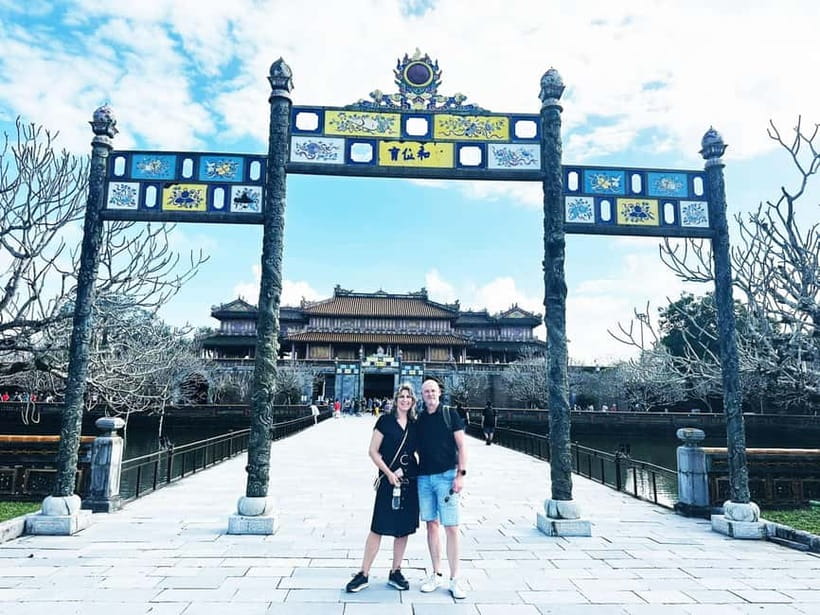
The tour includes Dien Tho Palace (Cung Diên Thọ), described as the Queen Mother’s residence. You will be shown the scale and the carved details, and the guide frames it in an elegant style. Even if you are not an ornament-spotter, this stop helps you understand that imperial power was shared and represented through family roles, not only through the king.
After that, you visit Hưng Tổ Miếu (Thế Miếu Huế). This is a temple dedicated to worshiping the 10 Kings of the Nguyen Dynasty. Temples like this turn politics into ritual. The purpose becomes more than remembrance. It supports the idea of continuity, that rulership is linked across generations.
If you want to understand how dynasties maintain legitimacy long after battles, these stops are key.
Nine Dynastic Urns and Hien Lâm Các: Minh Mạng to epiphanies
Next you will see the Nine Dynastic Urns (Cửu Đỉnh Huế). These were commissioned by Emperor Minh Mang in 1835, and the set includes a total of 162 images cast and carved on 9 bronze urns. The sheer specificity here helps. It is not “lots of bronze.” It is a planned collection tied to imperial storytelling and commemoration.
The final listed highlight is Hien Lam Pavilion (Hiển Lâm Các), built in 1821 to 1822. The explanation includes that it is considered the place where emperors had their epiphanies. That phrasing can sound poetic, but the function is practical: it points to a space where reflection and decision-making were imagined as part of governance.
By the time you reach the end, the tour has handed you a full arc. You start with symbols of power, move through ceremony and leisure, and end with objects and spaces tied to memory and rule-making.
Finish at Cửa Hiển Nhơn, then use your leftover time well
The walk ends at Cửa Hiển Nhơn. That exit point is useful because it lets you keep exploring Hue at your own pace right after the guided structure fades.
My advice is simple: use the extra time to slow down in the places you connected with most. If you liked theater explanations, linger around the cultural areas. If you got garden design ideas, spend a little time absorbing the space instead of treating it like a quick stop.
The tour is built to give you a map in your head. After that, you can follow your curiosity without losing the plot.
Price and logistics: what $23 really buys
At $23 per person, you are paying mainly for three things: an English-speaking guide, bottled water, and the guided walkthrough of the Imperial City highlights. The tour length is about 150 minutes, which is a sweet spot for concentration without fatigue.
The biggest separate cost is entry. Imperial City entrance ticket is 200,000 VND per adult, and combos can be 420,000 VND (with 2 tombs) or 530,000 VND (with 3 tombs, valid 2 days). So your real cost is a two-part equation: tour fee plus site tickets.
Is it good value? For me, yes, if you want clarity. Hue’s imperial layout is not always intuitive. A good guide turns confusing walls into a logical sequence of access rules, court ceremonies, and imperial symbolism.
If your travel style is mostly DIY, you might feel the site tickets and paid guide time add up. But if you want your visit to feel coherent, you are buying time saved and meaning gained.
Who should book this Hue Imperial City and Forbidden City tour
This is a strong fit for you if:
- you want an English guide to connect Nguyen Dynasty details to what you see
- you prefer a private group pace with short, planned stops
- you care about understanding court ceremonies, not only getting photos
- you want a 2 to 2.5 hour commitment that is doable even with a busy Hue schedule
It may be less ideal if you are rushing through Hue and plan to barely spend time at each space. This tour works best when you are willing to slow down for the guide’s explanations.
Book it or skip it
I would book it if your goal is to walk away knowing the story behind Hue Imperial City. The combination of palace highlights, royal garden and rest spaces, the oldest preserved Nguyen theater, and the specific imperial details like Minh Mang’s urns makes the time feel well used.
I would consider skipping or switching to a cheaper option if you already plan to spend long hours inside museums and need total freedom without a guided pace. Otherwise, the private structure and English guide support are exactly what turn this complex site into something you can actually remember.
FAQ
What is the duration of the Hue Imperial City and Forbidden City walking private tour?
The tour duration is 150 minutes, about 2.5 hours.
Where do I meet the tour guide?
You meet the guide at the 4 Bronze Cannons area near Ngan Gate (Cửa Ngăn), and the guide holds an A4 paper with your name.
Is the Imperial City entrance ticket included in the price?
No. The Imperial City ticket is not included.
How much is the Imperial City entrance ticket?
The entrance ticket for the Imperial City is 200,000 VND per person (adult).
Are there combo ticket options if I want tombs too?
Yes. There is a combo for 420,000 VND per adult for the Imperial City with 2 tombs, and a combo for 530,000 VND per adult for the Imperial City with 3 tombs, valid for 2 days.
What does the tour include?
It includes an English-speaking guide, bottled water, and a 2.5-hour guided tour of the Hue Imperial City. Hotel pickup and drop-off are included if you choose that option.
What language is the tour guide?
The tour guide speaks English.
Is this a private tour?
Yes. It is a private group tour, only for you with your guide.
Where does the tour finish?
The tour finishes at Cửa Hiển Nhơn.
What is the cancellation policy?
You can cancel up to 24 hours in advance for a full refund.
Hue, Citadel and Tombs
- Hue Customizable Tour with Imperial Citadel & Forbidden City★ 4.9 · 937 reviews
- Hue :Exploring Royal City with Multi Options and Dragon Boat★ 5.0 · 675 reviews
- Hue City Tour Full Day – Group Tour★ 4.7 · 518 reviews
- From Hue: DMZ Tour with Vinh Moc Tunnels and Khe Sanh Base★ 4.9 · 503 reviews
- Hue: Private Car to Hoi An via Fabulous Stops★ 5.0 · 371 reviews
Other Hue Vietnam tours our reviewers keep coming back to
- Hue Royal Tombs Tour: Visit Best Pagodas & Mausoleums
★ 4.9 · 19 reviews - Hue Imperial city walking tour and optional royal tombs
★ 4.7 · 19 reviews - Hue Imperial City & Abandoned Water Park Tour by E-Scooter
★ 5.0 · 20 reviews - From Hue: Private Half-Day DMZ Tour with Vinh Moc Tunnels
★ 4.8 · 22 reviews - Phong Nha National Park: Paradise Cave Half-Day Tour
★ 5.0 · 23 reviews - Guided Private Tour – Explore Hue’s Royal Tombs & Thien Mu
★ 5.0 · 24 reviews
Hue Imperial City and Royal Tombs, compared.
 ★ 5.0Hue to Hoi An ( Hoi An to Hue) Top Gear with Lefamily Riders Tours ( 1 way)From $503,156 reviews
 ★ 5.0Easy Rider private tour via Hai Van pass from Hue – Da Nang – Hoi An (1Way|Loop)From $551,542 reviews
 ★ 4.9Hue Customizable Tour with Imperial Citadel & Forbidden CityFrom $12937 reviews
 ★ 4.6Imperial City, Hue: Day Tour from Hoi An and Da NangFrom $47830 reviews
 ★ 5.0Easy Rider From Hue Da Nang Hoi An Via Hai Van Pass With Mister TFrom $58769 reviews
 ★ 4.7Da Nang/Hoi An: Hue Imperial City via Hai Van Pass & LunchFrom $9753 reviews
 ★ 5.0Hue to Dn/Hoi An: Hai Van Pass, beaches & Mt Monkey or vice versaFrom $59743 reviews
 ★ 5.0Hue: Imperial City Walk, Motorbike Tour & Private Car OptionsFrom $7732 reviews
Also in these Vietnam lists