
REVIEW · WORKSHOPS
Hanoi Knife Making Traditional Workshop
A hot lesson in Vietnamese metalwork. In Da Sy village, you can turn a chunk of steel into a working knife through hands-on forging. Expect English guidance, real craft talk, and a souvenir that feels genuinely useful.
Two things I love about this class are how much you do yourself, and how personal the teaching feels. With guides like Tee, Nathan, Khoi, and Minh translating, you get clear directions plus a chance to pick your blade shape before you start. The other big win is the master craftswoman side of it, including teachers like Mrs. Tuyen, who guides the most important steps.
One drawback to plan for: it is hands-on, but not every step is truly DIY. Safety limits mean the master and workshop tools handle the riskiest parts, so if you expect to be fully independent from start to finish, you may feel a little constrained.
In This Review
- Key highlights you will care about
- Da Sy Village, the place where knife making still pays rent
- Getting picked up in Hanoi, and what to wear for 3 hours of metalwork
- Choosing your knife shape before the hammer starts
- From sketch to embers: forging the blade the right way
- Grinding, sharpening phases, and that tar-based wash step
- Handles, finishing, and taking home a knife you will want to use
- Price and value: why $50 can feel fair for what you get
- Who should book this, and who might want a different kind of activity
- Should you book the Hanoi Knife Making Workshop?
- FAQ
- How long is the Hanoi knife making class?
- Does the class include pickup from my hotel in Hanoi?
- Is the workshop taught in English?
- What is included in the $50 price?
- What should I bring, and what is not allowed?
- Are there any extra charges on holidays?
Key highlights you will care about
- Da Sy forging craft near Hanoi: a village trade built around metalwork for generations, now tied to farm tools.
- You choose your knife style: pick from options or bring an idea, then follow that shape all the way to the finished blade.
- Hammering and shaping with a real workflow: forging, shaping, and finishing happen as a complete process, not a demo.
- Tar-based wash during sharpening: you learn about a multi-phase sharpening routine, including a special chemical soak.
- English speaking guide support: names you may meet include Tee, Nathan, Khoi, and Minh, who help translate step-by-step.
- Pickup and a take-home knife: hotel transport plus instruction and equipment are wrapped into the $50 price.
Narrowing it down? These Hanoi tours kept surfacing in our reviews.
- Hanoi Jeep Tour: Food, Culture and Fun by Vietnam Army Jeep★ 5.0 · 15,222 reviews
- Full-Day Ninh Binh Highlights Tour from Hanoi★ 5.0 · 7,761 reviews
- Hanoi: Ha Long Bay Day Cruise – Swimming, Meal, Kayaking★ 4.7 · 7,415 reviews
- Hanoi: Water Puppet Show Tickets★ 4.6 · 7,029 reviews
Da Sy Village, the place where knife making still pays rent
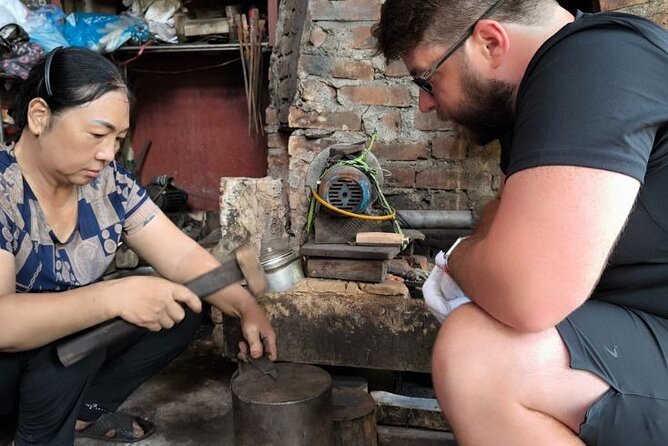
This workshop is set outside Hanoi in Dong Bac, in the Da Sy village area, known for forging work that stretches back centuries. In the past, the craft was tied to making weapons during war years. Today, the same core skills support agricultural tools, which is a nice reality check. This is not a craft show. It is a working trade that still matters locally.
You will also hear the story of how forging survived by adapting. The metal skills and habits are the same, but what gets made shifts with the needs of the village. That context helps the class feel more grounded, because you are learning a process that has been refined for practical results, not just for tourists.
And yes, the metal side is the star. You will be close to heat, tools, and serious technique. That is why the workshop runs like a controlled studio. It is active, but it stays intentional, with a guide and master craftsperson guiding your hands so you learn without turning it into a slapstick comedy.
Getting picked up in Hanoi, and what to wear for 3 hours of metalwork
The class runs for 3 hours. You will want to check availability for the starting time that fits your schedule. Pickup is included from your hotel, and the instruction is to wait about 5 minutes in the lobby so you are ready when the car arrives.
What matters most for your comfort is clothing and shoes. Bring comfortable shoes you do not mind getting a little scuffed. The session includes time outdoors or semi-outdoors depending on the workspace, plus time moving around the workshop floor.
Also remember what the workshop requests: no alcohol or drugs. That is not just a rule for liability. It also keeps the experience safer and easier when you are handling tools, moving around hot materials, and standing in the working rhythm of a craft shop.
Finally, it is described as small group, and from what people report, you may see setups ranging from small groups to one-on-one when availability allows. Either way, you are not crammed into a big bus-sized crowd, which helps the guide actually keep an eye on what you are doing.
Choosing your knife shape before the hammer starts
One of the most enjoyable parts is the moment you choose what you will make. You typically get options to select from, and some classes allow you to choose a design you like or work from an example idea.
This matters more than it sounds. The knife shape you pick affects the whole workflow, from how the blade outline is sketched onto the metal sheet to how it will be forged and later ground and finished. You are not just making something generic. You are building toward a specific result.
When the guide is translating, you can usually get straight answers on what you are picking. Guides like Tee, Nathan, Khoi, and Minh have been praised for clear English explanations, and that makes a real difference when you are deciding between styles and thinking ahead about the final look.
And here is a small practical tip: if you are unsure which design to choose, go for something you can picture using at home. People tend to end up happiest when they pick a blade style they genuinely like, not just a cool-looking one.
From sketch to embers: forging the blade the right way
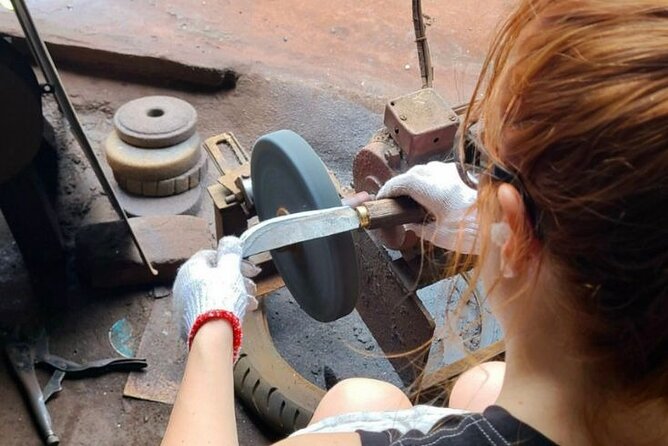
The knife-making process follows a logical sequence, and the class keeps you moving through it. Here is what you should expect, step by step.
First comes designing and marking. You begin by sketching the shape of the blade on a metal sheet. The metal is selected for durability, and getting your outline right sets the rest of the process up for success.
Next is forging. You cut out the blade and tang, then thrust those pieces into crackling embers. That hot stage is where the metal becomes workable. You are learning how heat changes metal behavior, so you can shape it without fighting it.
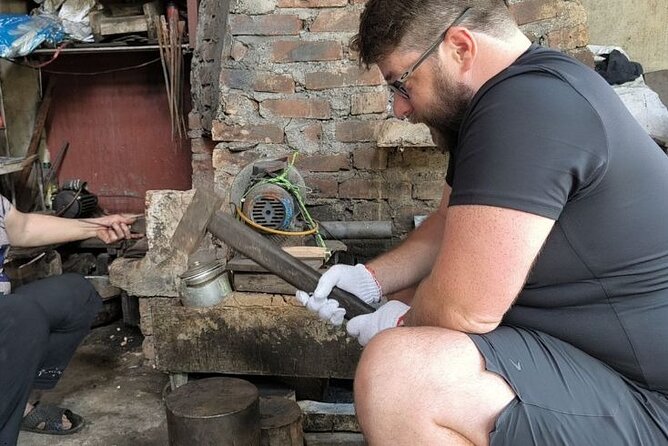
Then comes shaping, which is the part most people picture. You alternate blows with the maker to form the blade. The rhythm is guided, and the master’s role is to correct what needs correcting as you go, especially if your angle or strike pattern drifts.
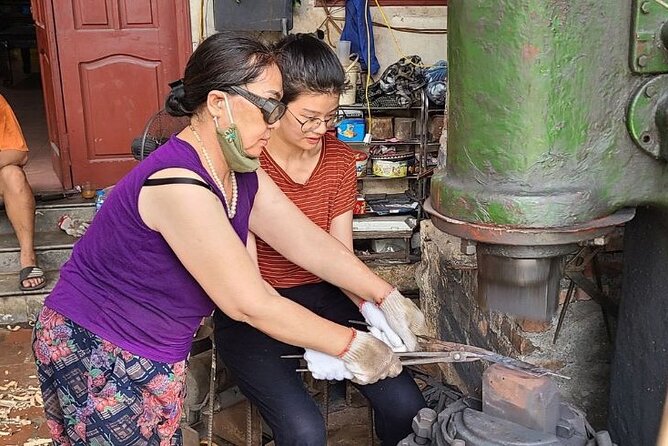
When imperfections need trimming, the class uses a hydraulic cutting machine. This is a good example of why this workshop is hands-on but not purely DIY. That machine is there to keep the work precise and safe. You still learn the steps, but the workshop team keeps the outcome clean.
If you want the class to feel satisfying, watch how the master demonstrates, then mirror it. Most of the best moments come when you understand what the maker is trying to accomplish with each controlled movement.



Grinding, sharpening phases, and that tar-based wash step
Once the blade has shape, the focus shifts to getting it truly sharp and stable. That is where sharpening and finishing happen in phases, not just one quick session with a stone.
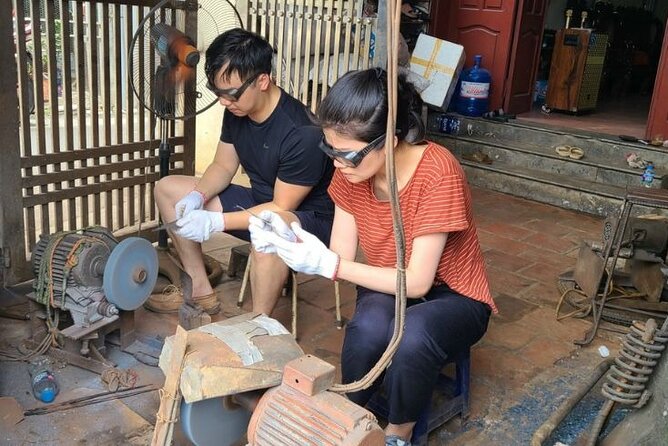
You should expect the blade to be sharpened on a grindstone, with multiple phases. One phase involves soaking the blade in a tar-based chemical wash, described as a secret family recipe. The big takeaway for you is that this is part of how they manage the blade’s final condition, not an optional flourish.
If you are the curious type, this is a fascinating moment. It connects the traditional craft story with real metallurgy and finishing logic. The work is still practical, still repeatable, still aimed at an end product that holds up.
From the teaching perspective, this also helps keep the experience manageable. You are not expected to invent sharpening technique on the spot. Instead, you follow a trained workflow and learn what each step is trying to fix, from surface refinement to final edge quality.
People often come away impressed by the sharpness. The knives are repeatedly described as razor sharp and practical, meaning the workshop does not just focus on the forging romance. It cares about what you will actually have when you leave.
Handles, finishing, and taking home a knife you will want to use
The knife does not end at the blade. Many classes include time on handle work and finishing, and that is where the souvenir becomes personal.
You might carve or shape part of the handle, and at least some sessions include guidance on tempering the metal and crafting the handle to fit comfortably. That comfort piece is underrated. A knife that fits your grip feels like yours, not like something you just bought at a shop.
Some people even describe choosing handle details or working on them enough to make the final knife feel balanced in the hand. If you get a guide who’s paying close attention, you can often make small adjustments that improve how the finished knife feels.
When you finish, you take the knife home. That is the whole point of paying and traveling for this class. A well-made handmade knife becomes a memory you can actually hold, not only a photo on your phone.
You may also have a wrap-up moment at the workshop where you can chat and cool down, sometimes over tea and a snack. That kind of time is valuable because it lets you ask craft questions, hear local stories, and understand how the craft lives beyond the workshop floor.
Price and value: why $50 can feel fair for what you get
The price is $50 per person, and the workshop includes several things that usually cost extra elsewhere: an English speaking guide, English instruction, the master craftsperson, equipment, and the products you make. Hotel pickup and a bottle of water (500ml) are also included.
So the value question becomes simple: are you paying for a show, or paying for training plus a take-home item? Here you are paying for a full process where you actively participate, then leave with your knife.
To judge value in a practical way, think about replacements. If you tried to buy a decent forged knife later, you would likely spend more than you expect, and you would not get the story of how it was made step-by-step. This class gives you both, the object and the process, with enough guidance that true beginners can keep up.
There is also a small seasonal pricing reality to note. The class may add a $10 surcharge on New Year, Tet, Liberation Day or Reunification Day (30/4), International Workers’ Day (01/05), and National Day (02/09). If you are traveling around those dates, factor that into your budget.
Who should book this, and who might want a different kind of activity
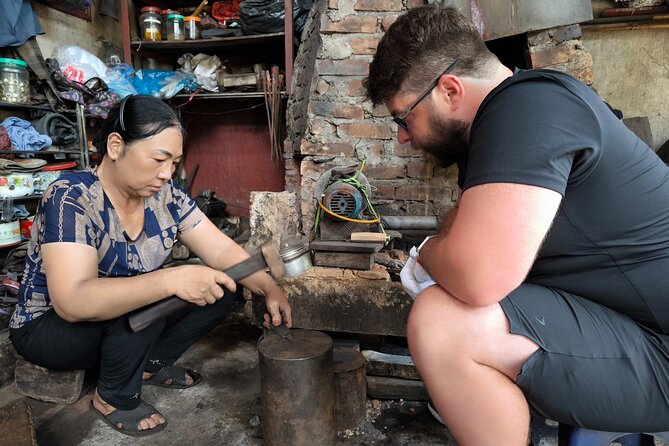
Book this workshop if you want a hands-on craft day in Hanoi that feels real and local. It is especially good if you like the idea of making something practical with your own hands. People in the feedback repeatedly highlight the hospitality and patience of the workshop family, and guides like Tee, Nathan, Khoi, and Minh are noted for translation that makes the experience click.
It is also a good fit for beginners. The process is structured, the teachers demonstrate, and you get hands-on time without needing prior DIY experience. Even teens have enjoyed it, which tells you the pace is beginner-friendly.
You might consider a different activity if your goal is pure independence. Some work is naturally done by the workshop team, including steps involving dangerous tools or machines. The workshop will not be safer just because you are excited. Safety is part of the deal.
Finally, there is an age note: it is not suitable for people over 95 years. If that might apply to you or someone traveling with you, it is smart to skip and choose a less physically demanding option.
Should you book the Hanoi Knife Making Workshop?
If you want a memorable Hanoi experience that results in an actual usable souvenir, I think this workshop is a strong yes. The combo of English guide support, a genuine master craft teaching style, and a step-by-step path from sketch to finished knife makes the $50 feel reasonable, especially with pickup and the knife included.
Choose it if you like practical crafts, metalwork, or food-safe, shop-made items you can use at home. Pass if you only want photos, or if you expect to do every single step with no workshop assistance. Most people find the balance just right.
FAQ
How long is the Hanoi knife making class?
The experience runs for 3 hours. Starting times can vary, so you should check availability for the schedule that fits your day.
Does the class include pickup from my hotel in Hanoi?
Yes. Pickup is included, and you are asked to wait about 5 minutes in the hotel lobby for the guide.
Is the workshop taught in English?
Yes. There is English speaking instruction and a live tour guide who speaks English.
What is included in the $50 price?
The price includes the English speaking instruction, the master, equipment, products (what you make), and one bottle of water (500ml). Pickup is also included.
What should I bring, and what is not allowed?
Wear comfortable shoes. Alcohol and drugs are not allowed.
Are there any extra charges on holidays?
Yes. There is a $10 surcharge on New Year and Tet holidays, Liberation Day or Reunification Day (30/4), International Workers’ Day (01/05), and National Day (02/09).
Other Hanoi tours our reviewers keep coming back to
- Hanoi Vespa After Dark Street food + Train Street+ Live Music
★ 5.0 · 18 reviews - (Free Pick-up) Vietnamese Body Massage in Hanoi City
★ 5.0 · 18 reviews - The Insider’s Hanoi,Train Street, Countryside Highlight by Vespa
★ 5.0 · 18 reviews - Skip the line: Thang Long Water Puppet Theater Entrance Tickets
★ 4.0 · 18 reviews - Hanoi Street Food Tour and MORE
★ 5.0 · 18 reviews - Hanoi – Hoa Lu – Tam Coc – Mua Cave – 1 Day / By Luxury Limousine & Small Group
★ 5.0 · 18 reviews
Workshops, compared.
 ★ 5.0Hanoi Cooking Class: Culture, Local Market & Meaning CSR ImpactFrom $395,147 reviews
 ★ 5.05 Traditional Dishes Hanoi Cooking Class with Market TripFrom $354,890 reviews
 ★ 4.9Hoi An: Vietnamese Coffee Culture and Coffee Making ClassFrom $144,006 reviews
 ★ 4.9Hoi An: Vietnamese Foldable Lantern Making ClassFrom $103,742 reviews
 ★ 5.0Cooking Class Hoi An:Local Market, Basket Boat, Fishing & CookingFrom $283,660 reviews
 ★ 5.0Hoi An Cooking Class(Market,BasketBoat Crabfishing&Cooking Class)From $283,386 reviews
 ★ 4.8From Hoi An: Market Tour, Basket Boat Ride and Cooking ClassFrom $172,208 reviews
 ★ 5.0Hoi An Full Lantern Making Class- A special Foldable lanternFrom $152,007 reviews
Also in these Vietnam lists