
REVIEW · WORKSHOPS
Hanoi Knife Making Traditional Workshop
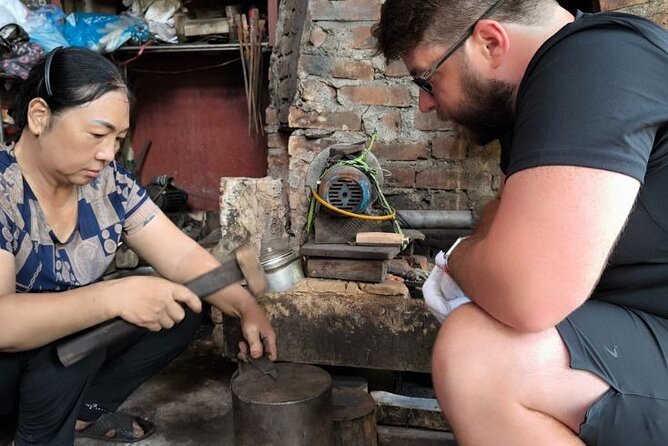
A knife class gets your hands dirty. In Hanoi, you spend about 3.5 hours in a traditional forging workshop where you can watch and try the real steps of knife making, not a slideshow. I especially liked the patient family workshop feel, and how the makers keep things practical even when you are learning from zero.
Next, I love that the process is explained step by step, from sketching the blade shape to the final sharpening stages, so you leave understanding what you did and why it matters. You even meet the bladesmiths behind the trade, and I liked having Nathan as an English guide to keep pace and translate the key moments.
One thing to plan for: this activity is weather dependent and requires moderate physical fitness, and lunch is not included. If you are the type who hates standing around, you will still be busy here, but you should budget for a meal afterward.
In This Review
- Key highlights I’d bet you’ll care about
- Forge Village, Not Just a Souvenir Stop
- The Real Steps: Sketch to Sharpening
- Design: choosing the blade shape on metal
- Forging: cut, heat, and plunge into embers
- Shaping: alternating blows and correcting imperfections
- Sharpening: grindstone work and a tar-based wash step
- What the Village Craft Teaches Beyond the Knife
- How the 3.5 Hours Usually Feels (and What to Watch)
- Price and Value: Is $50 Fair?
- Transportation and Comfort: Getting Out of Hanoi Smoothly
- Who Should Book This Knife Making Class?
- Should You Book Hanoi’s Knife Making Workshop?
- FAQ
- How long is the Hanoi knife making workshop?
- Is pickup from Hanoi included?
- How big is the group?
- Do I get an English guide?
- What is included in the price?
- Is lunch included?
- Will I be able to take the knife home?
- Is the workshop weather dependent?
- What fitness level is required?
- What is the cancellation policy?
Key highlights I’d bet you’ll care about
- Up to 10 people means you get real attention, not the usual factory-tour vibe.
- Pickup offered plus an air-conditioned vehicle makes the outskirts drive painless.
- Hands-on knife making from sketch to sharpening, using provided iron material.
- Seasoned craft village background, with generations of forging skills behind it.
- A special tar-based chemical wash step (a family recipe) that adds drama to the process.
- English guidance from Nathan helps you understand the why, not just the what.
Narrowing it down? These Hanoi tours kept surfacing in our reviews.
- Hanoi Jeep Tour: Food, Culture and Fun by Vietnam Army Jeep★ 5.0 · 15,222 reviews
- Full-Day Ninh Binh Highlights Tour from Hanoi★ 5.0 · 7,761 reviews
- Hanoi: Ha Long Bay Day Cruise – Swimming, Meal, Kayaking★ 4.7 · 7,415 reviews
- Hanoi: Water Puppet Show Tickets★ 4.6 · 7,029 reviews
Forge Village, Not Just a Souvenir Stop
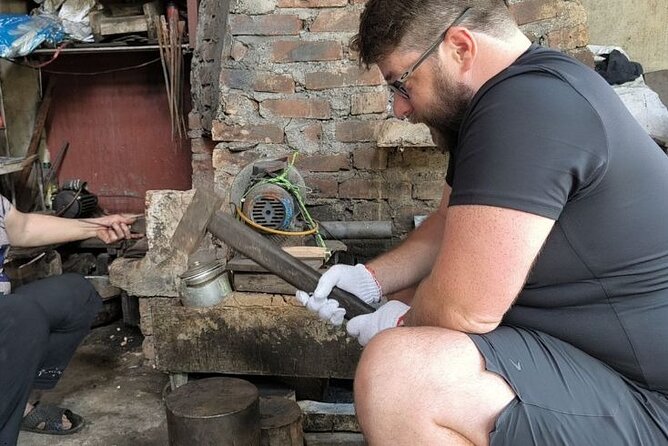
This is a hands-on Hanoi knife making class that takes place in a traditional craft area on the outskirts of the city. The workshop is tied to a village known for forging, with a trade that stretches back several hundred years. Long ago, this kind of forging work supported warfare needs. Today, the same skills often produce agricultural tools, which is a useful detail because it keeps the whole experience grounded in everyday work, not only showpieces.
The first practical win is the small group size. With a maximum of 10 travelers, you are not stuck watching from the back. You get pulled into the process, and that changes everything. You will still be guided, but you are participating.
The second win is how the workshop is structured around a simple knife. That matters because knife making can sound intimidating. A simple blade gives you a clear path through the steps without trying to replicate complicated gear. The result is a souvenir you can actually be proud of, because you made it through the work itself, not just stamped your name on something.
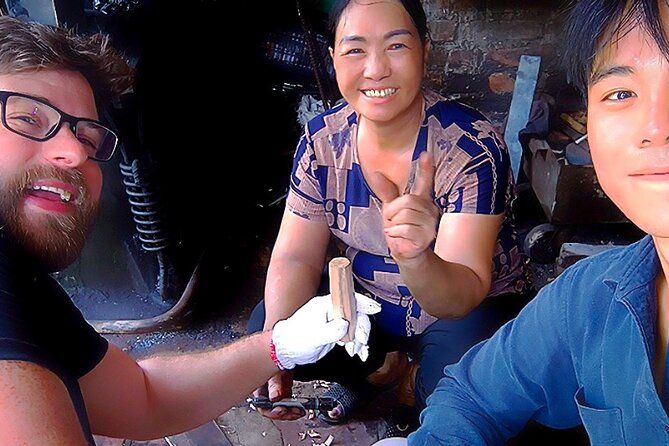
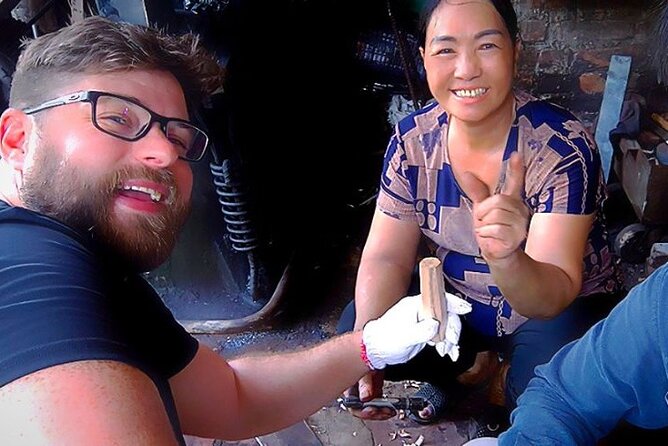
You’ll also be meeting locals, chatting as you go, and getting a sense for what this craft means to the family running the workshop. That social element is not fluff. It is part of understanding why a maker takes their time with each step.
The Real Steps: Sketch to Sharpening
Knife making here is taught as a sequence. You do not just swing a hammer and hope for the best. You move through distinct phases that you can see and feel.
Design: choosing the blade shape on metal
You start with designing the knife. The maker shows you how the blade shape gets sketched on a sheet of metal. You can also choose the shape details, and the key point is that the metal is selected for durability, not random scrap. This is where you begin learning that good tools start long before heat and hammering.
Forging: cut, heat, and plunge into embers
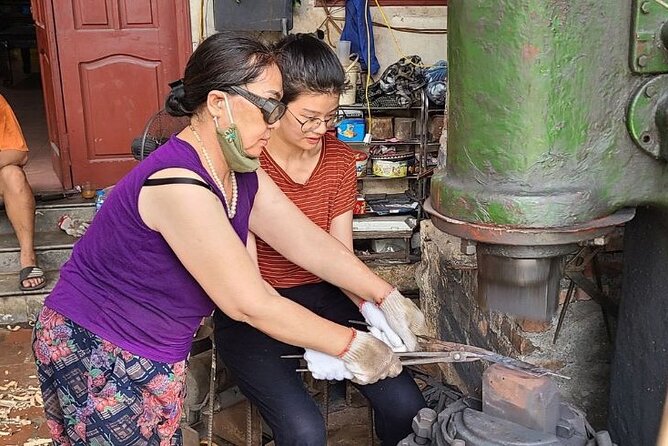
Next comes the forging stage. You will cut out the blade and the tang, which is the part that extends into the handle, using tools like a hammer, cutter, and anvil. Then the metal goes into crackling embers. That moment is often the most memorable because it turns the room into a working forge, with heat and timing that you can’t simulate at home.
This is also where the makers’ patience really shows. If you make a mistake, they do not panic. They coach and keep you on track.



Shaping: alternating blows and correcting imperfections
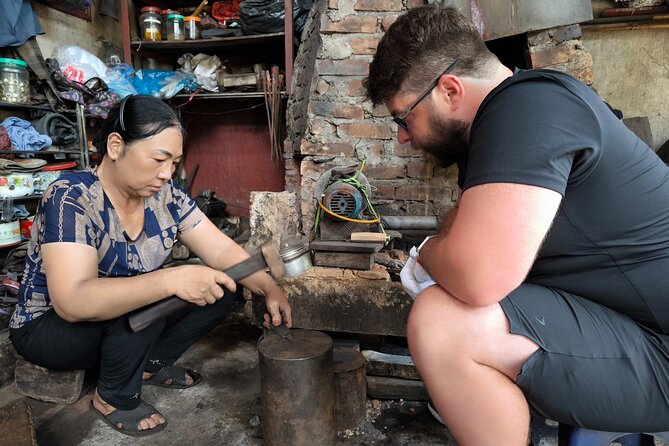
After forging heats the metal into the right starting shape, you move into shaping. You alternate blows with the maker to shape the blade. This is a skill based step. You learn how small changes in angle and force affect the final form.
If there are imperfections, they are trimmed by a hydraulic cutting machine. This is a nice reality check. Traditional craft does not mean ignoring modern tools. It means using the best method available to reach the correct result.
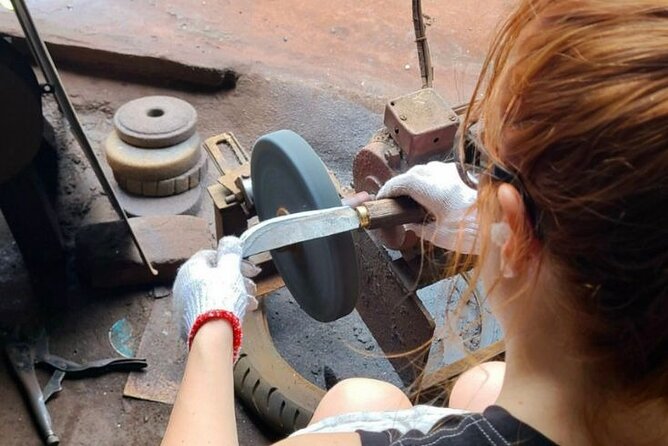
Sharpening: grindstone work and a tar-based wash step
Then you finish with sharpening. You use a grindstone through multiple phases, and one stage includes soaking the blade in a tar-based chemical wash. The info says it is a special recipe from the family, which explains why it is not just a random chemical step. It is part of how they prepare the blade for the next stage and for finishing.
You leave with a knife you helped create through the key phases, which is a big deal for value. Many classes let you touch a tool but do not fully walk you through the full lifecycle of making the blade.
What the Village Craft Teaches Beyond the Knife
Even if you only came for the souvenir, you’ll probably walk away with a new respect for old-school metalwork. The makers are working in a tradition that used to supply weapons during the Vietnam wars. Today, they focus on agricultural implements, meaning the skill still supports local livelihoods.
That shift matters. It’s easy to romanticize forging as a purely historical practice. Here, you see how the craft adapts. The methods stay, but the end product changes with real local needs.
You also get a sense of how training happens. One review highlights that the family starts apprentices young, around 12 years old. Whether you are hearing that as history or a workflow expectation, it gives you perspective on why the makers move with confidence. This is not just hobby knowledge. It is learned practice over years.
And the people factor is real. The class is led with English guidance, and the family members stay patient, especially when you are learning the basics of working metal. In a lot of tourist activities, the staff rush to protect their schedule. Here, the feel is different. The tone is more like a workshop where teaching is part of the work.
How the 3.5 Hours Usually Feels (and What to Watch)
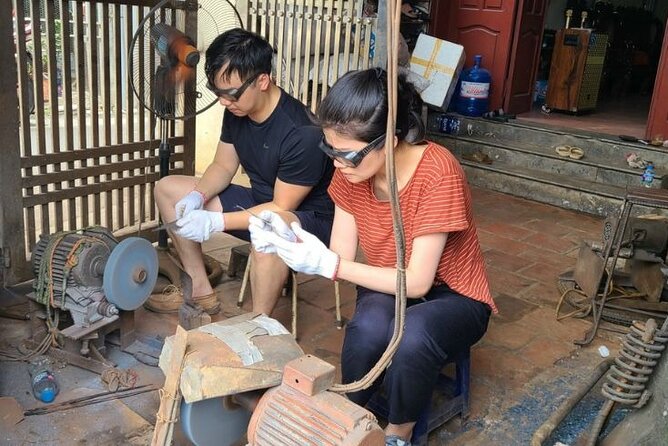
The experience runs about 3 hours 30 minutes. That timing is long enough for you to feel like you made something, but not so long that you need a full day off your itinerary.
You should plan for a moderate physical fitness level. The most honest way to interpret that is: you’ll be participating in active work, and you will likely be standing and moving around for stretches. If you have mobility limits, you should read that requirement carefully before booking.
Weather matters too. The experience requires good weather, and if it is canceled due to poor conditions, you will be offered a different date or a full refund. That matters in Hanoi, where plans can change fast. If you are booking during a rainy spell, keep some flexibility.
Group size also changes the pace. With up to 10 travelers and an English tour guide, the class has room for explanation and correction. That means you might not move through stages at the speed of a strict demo. It is better for learning. It does slow the vibe a bit, but it is usually what you want.
Also note what is not included: lunch and tips. Since lunch is not part of the package, I recommend you plan to eat before you go or shortly after. This prevents that rushed, hungry scramble that can turn a fun workshop into a grumpy one.
Price and Value: Is $50 Fair?
The price is listed at $50. For a 3.5-hour experience, that can feel either low or high depending on what is included. Here, you get a few important value anchors.
Included items cover:
- an air-conditioned vehicle for pickup and the ride out
- the iron material used for your knife
- an English tour guide
That means you are not paying extra for the basic materials and you are not stuck arranging transport on your own. And because the group is capped at 10, you are getting a more individualized workshop setting than you would from a larger tour.
What costs extra:
- lunch is not included
- tips are not included
If you treat this as a hands-on craft lesson plus a keepsake knife, $50 is a reasonable trade. If you came expecting it to feel like a full manufacturing factory with unlimited output, you may feel constrained by the simple knife scope. But for most people, that “simple” focus is exactly the point, it keeps learning achievable.
There is also mention of group discounts. If you are traveling with friends or family, it can become even better value. In that case, you can share the experience without doubling the cost.
Transportation and Comfort: Getting Out of Hanoi Smoothly
You get pickup offered, and you travel by air-conditioned vehicle. That is a big practical advantage if you are basing yourself in central Hanoi and do not want to figure out a ride to the outskirts on your own.
The transfer is also part of the experience. As you go out toward the forging village area, you get a sense of how far the city rhythm is from the craft rhythm. Hanoi can feel loud and fast. This trip is a structured reset.
Since the class runs about 3.5 hours, you should think of it as a half-day commitment. Plan the rest of your day accordingly. You’ll be done in time to eat afterward and still enjoy Hanoi, but you probably will not want to schedule something intense immediately before or right after.
If you get motion sick easily, the air-conditioned vehicle helps, but ride comfort still varies. I’m not seeing any special comfort guarantees listed beyond the vehicle type, so it is smart to be ready with your usual travel strategies.
Who Should Book This Knife Making Class?
Book this if you want something more hands-on than a typical Hanoi class. It’s a great fit for:
- first-timers who want to make something tangible
- travelers who enjoy craft villages and meeting locals
- people who like skill-based activities, not only photo stops
- anyone shopping for a non-standard souvenir that is actually useful
It’s also ideal if you like guided explanation. The English tour guide helps you understand what you are doing at each stage, especially the more technical steps like forging and finishing.
You might skip it if you need a very passive activity or if moderate physical fitness is a problem for you. And if you are planning around bad weather with no flexibility, remember the experience depends on good conditions.
Should You Book Hanoi’s Knife Making Workshop?
I think this is a smart booking for travelers who want a real workshop moment in Hanoi, not a quick demo. The biggest selling point is the full sequence, sketching and shaping through sharpening, plus the small group setting. You also get transport support, English guidance, and the iron material included, which keeps the value sensible at $50.
If you want a souvenir with a story, this is it. If you are hoping for a high-speed production experience, that is not the vibe. This is a craft class built around teaching and doing the steps properly.
FAQ
How long is the Hanoi knife making workshop?
It runs about 3 hours 30 minutes.
Is pickup from Hanoi included?
Pickup is offered, and you travel by air-conditioned vehicle.
How big is the group?
The experience has a maximum of 10 travelers.
Do I get an English guide?
Yes. An English tour guide is included.
What is included in the price?
The price includes an air-conditioned vehicle, iron material, and an English tour guide.
Is lunch included?
No, lunch is not included.
Will I be able to take the knife home?
Yes. You make a simple knife during the class and take it home.
Is the workshop weather dependent?
Yes. The experience requires good weather. If it is canceled due to poor weather, you are offered a different date or a full refund.
What fitness level is required?
You should have a moderate physical fitness level.
What is the cancellation policy?
You can cancel for a full refund up to 24 hours in advance. If you cancel less than 24 hours before the experience starts, the amount paid is not refunded.
Other Hanoi tours our reviewers keep coming back to
- Hanoi Vespa After Dark Street food + Train Street+ Live Music
★ 5.0 · 18 reviews - (Free Pick-up) Vietnamese Body Massage in Hanoi City
★ 5.0 · 18 reviews - The Insider’s Hanoi,Train Street, Countryside Highlight by Vespa
★ 5.0 · 18 reviews - Skip the line: Thang Long Water Puppet Theater Entrance Tickets
★ 4.0 · 18 reviews - Hanoi Street Food Tour and MORE
★ 5.0 · 18 reviews - Hanoi – Hoa Lu – Tam Coc – Mua Cave – 1 Day / By Luxury Limousine & Small Group
★ 5.0 · 18 reviews
Workshops, compared.
 ★ 5.0Hanoi Cooking Class: Culture, Local Market & Meaning CSR ImpactFrom $395,147 reviews
 ★ 5.05 Traditional Dishes Hanoi Cooking Class with Market TripFrom $354,890 reviews
 ★ 4.9Hoi An: Vietnamese Coffee Culture and Coffee Making ClassFrom $144,006 reviews
 ★ 4.9Hoi An: Vietnamese Foldable Lantern Making ClassFrom $103,742 reviews
 ★ 5.0Cooking Class Hoi An:Local Market, Basket Boat, Fishing & CookingFrom $283,660 reviews
 ★ 5.0Hoi An Cooking Class(Market,BasketBoat Crabfishing&Cooking Class)From $283,386 reviews
 ★ 4.8From Hoi An: Market Tour, Basket Boat Ride and Cooking ClassFrom $172,208 reviews
 ★ 5.0Hoi An Full Lantern Making Class- A special Foldable lanternFrom $152,007 reviews
Also in these Vietnam lists