
REVIEW · WORKSHOPS
Hanoi Knife-Making Class:Join the Legacy in Blacksmith’s Workshop
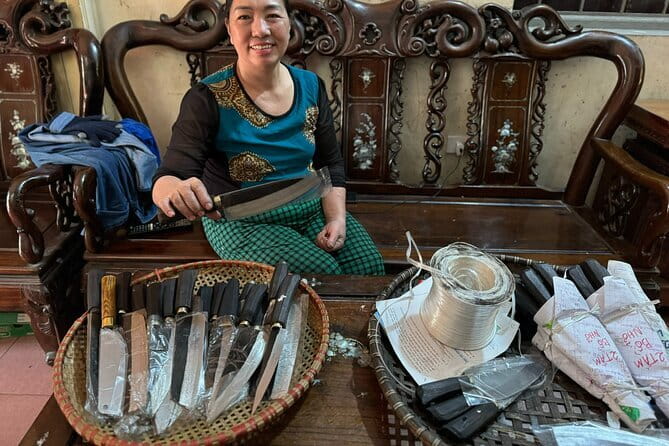
A real forge day beats a craft-day. This hands-on Hanoi class takes you into Da Sy, a centuries-old blacksmith village, where you’ll make an actual knife from scratch. I like the female-led forge with Tuyen, who has spent 44 years preserving the trade, and I like that you do the work step by step, not just watch. The one thing to plan for is effort and focus, this is not a casual, chill jewelry-style class.
You’ll follow a clear path from sketching your blade to forging the metal to shaping it, then finishing with sharpening on a grindstone. Expect expert help throughout, and the pace is real enough that you’ll feel tired in a good way at the end. In many sessions, guides like Mint, Nick, or Tulip help with explanation and timing, especially if your Vietnamese is basic.
You’ll leave with a functional, one-of-a-kind knife you made yourself, which is a very different souvenir than another mug. Just remember that bringing a blade home can trigger airline or customs rules, so check before you fly.
In This Review
- Key Points You’ll Feel During This Class
- Da Sy in Hà Đông: A Knife Village, Not a Classroom
- Meet the Female Artisan Tuyen and the 44-Year Craft
- Step by Step: Design, Forge, Shape, and Sharpen Your Knife
- 1) Design your blade
- 2) Forging: cut, heat, and hammer to form
- 3) Shaping: from rough form to cleaner edges
- 4) Sharpening on the grindstone
- The Tar-Based Sharpening Wash, Explained Simply
- Tools, Safety Gear, and the Hands-On Level
- Your Handmade Knife as a Functional Souvenir
- Guides Like Mint, Nick, and Tulip, Plus Group Size
- Price, Timing, and Who This Class Fits Best
- Who should book
- Who might hesitate
- Should You Book This Hanoi Knife-Making Class?
- FAQ
- How long is the Hanoi knife-making class?
- Where does the class start, and where does it end?
- What is the price per person?
- Is a mobile ticket provided?
- What parts of knife-making will I do?
- Do I get to take the knife home?
- Are tools and safety equipment included?
- What is the group size?
- Are gratuities included?
- Can I get a refund if I cancel?
Key Points You’ll Feel During This Class
- Da Sy is a real knife village, known for centuries of forging, not a staged demo space
- You work with Tuyen, an officially recognized female artisan with 44 years in the craft
- Design, forge, shape, and sharpen are all part of the session, hands on throughout
- Tar-based sharpening technique, described as a family secret passed down through generations
- Small group, max 10, so instruction stays practical and you get attention
- You take your knife home, a useful tool, not just decorative art
Narrowing it down? These Hanoi tours kept surfacing in our reviews.
- Hanoi Jeep Tour: Food, Culture and Fun by Vietnam Army Jeep★ 5.0 · 15,222 reviews
- Full-Day Ninh Binh Highlights Tour from Hanoi★ 5.0 · 7,761 reviews
- Hanoi: Ha Long Bay Day Cruise – Swimming, Meal, Kayaking★ 4.7 · 7,415 reviews
- Hanoi: Water Puppet Show Tickets★ 4.6 · 7,029 reviews
Da Sy in Hà Đông: A Knife Village, Not a Classroom
This experience starts in Đa Sỹ, Kiến Hưng, Hà Đông, Hà Nội, and that matters. You are not just sitting in a studio with a craft table. You’re working in the setting that built the tradition, where blades were historically tied to Vietnam’s wartime supply and local survival skills.
The session runs about 2 hours 30 minutes, which is long enough to feel like a full craft process, not a quick “try one step” activity. It also helps that the group is capped at 10 people, so the workshop stays focused and the artisans can keep an eye on your technique as you go.
If you want one true-feeling cultural break in Hanoi, this is a strong contender because it’s built around a trade. You’ll see why knife-making is both art and problem-solving: metal choice, heat control, shaping accuracy, and finishing all affect how the knife performs later.
Meet the Female Artisan Tuyen and the 44-Year Craft
One of the best parts here is the female-led forge. The class highlights Tuyen as the only officially recognized female artisan in the trade, with 44 years dedicated to keeping the craft alive. That’s not a marketing line. It shows up in how you’re taught, how patiently your work is corrected, and how seriously the craft is treated.
I also like that this isn’t framed as a trendy “look at the woman blacksmith” photo moment. It’s presented as a lifelong skill in a working workshop, and the guidance is practical. People in past sessions have praised her support for beginners and her ability to explain what to do next, in plain, doable steps.
You might also meet a guide such as Mint, Nick, or Tulip. Their job is to keep the class moving and make sure you understand what the artisans want you to do. One reason this matters is that knife-making has safety and timing built in. When communication is good, you spend more time learning and less time guessing.
Step by Step: Design, Forge, Shape, and Sharpen Your Knife
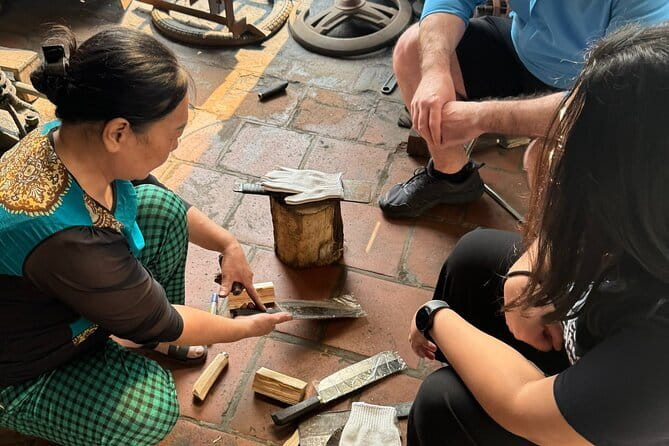
This class follows a structured workflow that makes sense for first-timers. You’re not just holding tools. You’re learning how each stage affects the next.
1) Design your blade
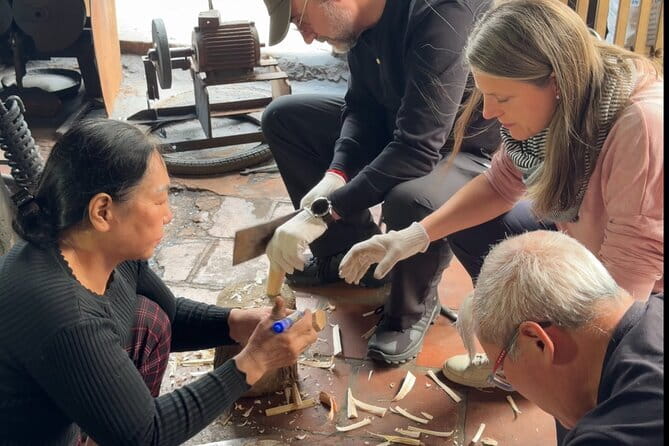
You begin by sketching your knife blade on selected durable metal. You’ll also be choosing what you want your blade and tang to become. This early part feels simple, but it’s where you set yourself up for success later. If your design is clear, shaping and finishing go smoother.



2) Forging: cut, heat, and hammer to form
Then comes forging. You’ll cut out the blade and tang using traditional tools such as hammers, cutters, and an anvil. After cutting, the metal is heated in a fiery forge so it’s workable.
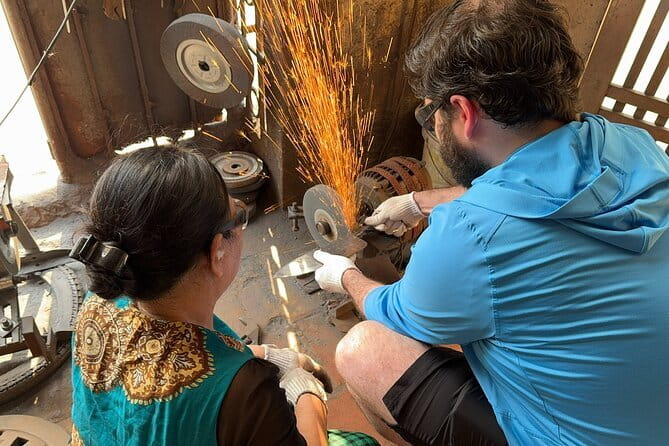
The class is hands on, and you’ll take turns hammering with artisans. You’re not expected to be a blacksmith on day one, but you are expected to participate, which is where the value is. You get the real feel of metal under heat, and you learn how much force and control matter.
3) Shaping: from rough form to cleaner edges
For shaping, you work side by side with artisans. The goal is to refine the blade into your chosen form, not just “make something that looks like a knife.”
A hydraulic machine is used to help refine rough edges for a smooth finish. That detail matters. It means you still get the traditional feel of forging and hammering, while also ending up with a better result than pure hand grinding alone.
4) Sharpening on the grindstone
Finally, you sharpen the blade on a grindstone. Sharpening is where patience shows. The grindstone steps are where your knife starts to act like a tool instead of a crafted block of metal.
One standout element is a rare technique that uses tar, described as a family secret. (More on that next.)
The overall rhythm of the class is not slow and decorative. It’s active. If you like learning through doing, you’ll likely enjoy it a lot more than a sit-and-watch workshop.
The Tar-Based Sharpening Wash, Explained Simply
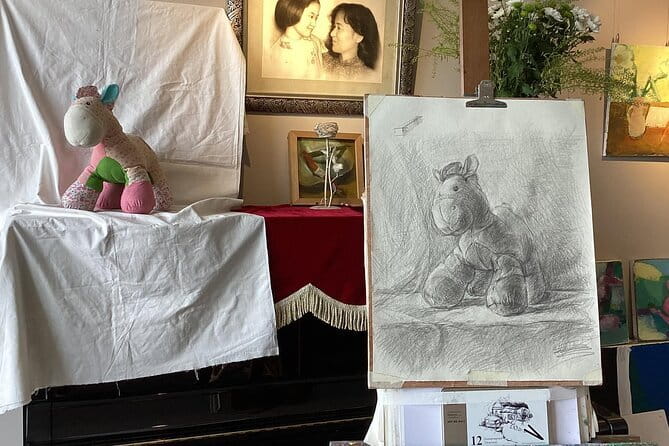
The sharpening process includes several steps, and one step features a tar-based wash, passed down through generations.
You don’t need chemistry knowledge to appreciate why it’s special. In practical terms, a finishing method like this can change how the blade edge is treated during sharpening. Even if the exact family recipe stays private, the message is clear: this is not a generic “use a stone and go” routine. There’s a tradition behind the finish.
This is also a great moment to slow down and pay attention. The blade is nearly ready by then, so small technique differences show quickly. If you want to understand what makes this village technique different from basic sharpening, this tar step is the clue.
Tools, Safety Gear, and the Hands-On Level
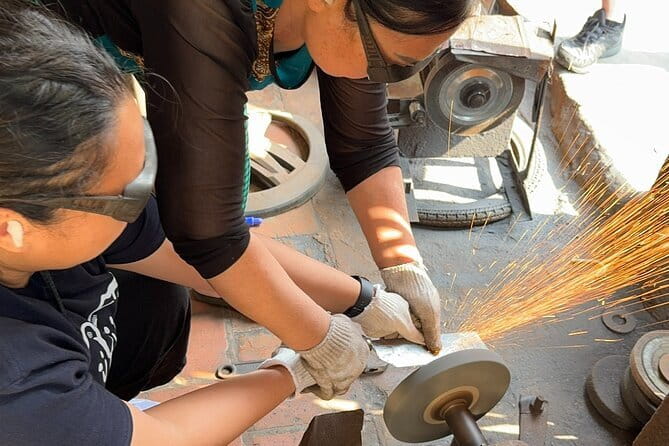
All tools are provided at the artisan’s house, and you also get safety equipment for knife making. That’s important for two reasons.
First, it lowers your mental load. You’re not chasing equipment, and you’re not bringing random tools from home. Second, safety is part of the trade. When the shop expects you to work with heat, hammers, and grinders, they also expect you to use proper protection.
In terms of effort, this is a more physical workshop than many craft classes. You’ll hammer, shape, grind, and sharpen. One participant comparison was that it isn’t a chill laid back class like some jewelry workshops. That’s a fair warning. If your idea of a vacation day is gentle stamping and chatting, you might find the pace demanding.
If you’re a beginner, that’s okay. Past classes have emphasized how skilled artisans guide people through each step, including beginners. The real trick is showing up ready to listen, then doing exactly what the artisan asks at each stage.
Your Handmade Knife as a Functional Souvenir
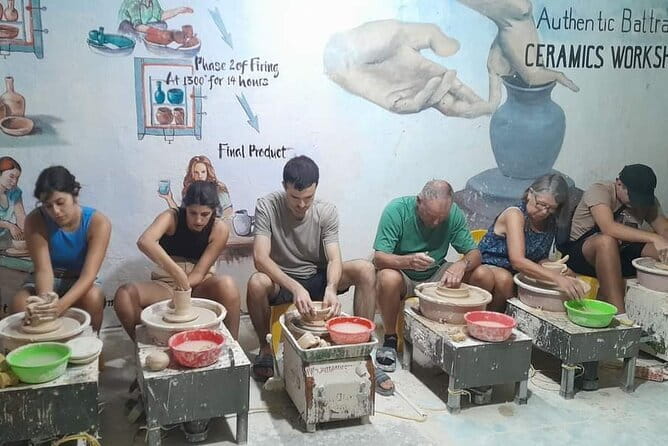
Yes, you take home what you make. The class is designed so you finish with a handmade knife that’s functional, meaning it’s intended for real use in the kitchen.
That’s a big deal for value. A $45-ish craft class can sometimes mean a decorative item you’ll keep in a drawer. Here, you’re making a tool. You’ll likely think about it every time you chop, cook, and clean.
One review example mentioned a knife around 14 cm, which suggests sizes can vary depending on your design choices. Plan for the fact that your finished knife might not match someone else’s exactly. The experience gives customization in handle and blade design, so your final product reflects your decisions.
Also, don’t ignore the practical side of travel: if you plan to fly, check your airline and destination rules for carrying a blade. One person specifically noted the need to check airport regulations before travel. It’s not scare talk, it’s just common sense when you’re bringing home a real cutting tool.
Guides Like Mint, Nick, and Tulip, Plus Group Size
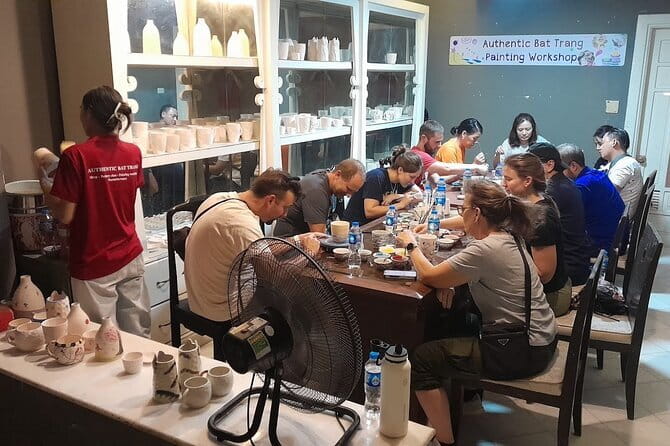
The workshop experience is supported by guides and interpreters who help you understand the steps and keep the timing right.
People have called out Mint for being personable and helpful, Nick for being friendly and for sharing Hanoi food recommendations, and Tulip for clear explanations and a warm approach. Even if you don’t get the same guide, the lesson is the same: the class works better when you can communicate quickly with someone who knows the process.
The small group size (max 10) also matters. In a larger group, your turn at hammering or grinding can feel rushed. Here, the workshop can slow down when you need instruction, especially for safety and accuracy.
And because you end back at the meeting point, you don’t have to worry about complex end-of-day travel puzzles after you’re done. You finish where you started.
Price, Timing, and Who This Class Fits Best
At $45.51 per person, this is priced like an activity class, but it includes more than most “souvenir making” tours. You’re getting:
- a full 2 hours 30 minutes craft session
- all tools and safety equipment provided
- step-by-step instruction through design, forging, shaping, and sharpening
- a real knife you take home
That’s why I think the value is strong, especially if you care about making memories that last beyond photos. A functional knife takes longer to produce and has more responsibility than most crafts, and that’s reflected here.
Who should book
This fits best if you:
- enjoy hands-on learning more than passive sightseeing
- want a culturally grounded activity in Hanoi beyond street food and museums
- like the idea of taking home something you actually use
Who might hesitate
Consider skipping if you:
- want a very relaxed class with minimal physical work
- are worried about carrying a blade home when flying
- have safety concerns and prefer to avoid hot shop environments
If you’re on your first trip to Hanoi and you want one “wow, I did that” day, this is a very solid pick.
Should You Book This Hanoi Knife-Making Class?
If you’re choosing between another craft lesson and a real trade experience, I’d book this one. The class does what good workshops do: it turns tradition into a process you can feel in your hands, with real instruction and a small group size.
The only real decision point is practical travel planning. If you fly, check blade regulations early. If you’re staying local or you can store the knife safely for your trip, you’ll likely get much more joy from the final product.
FAQ
How long is the Hanoi knife-making class?
It runs for about 2 hours 30 minutes.
Where does the class start, and where does it end?
It starts at Đa Sỹ, Kiến Hưng, Hà Đông, Hà Nội, Vietnam and ends back at the meeting point.
What is the price per person?
The price is $45.51 per person.
Is a mobile ticket provided?
Yes, the tour includes a mobile ticket.
What parts of knife-making will I do?
You’ll go through the process from design to forging and shaping, then sharpening on a grindstone.
Do I get to take the knife home?
Yes. You take home the knife you make.
Are tools and safety equipment included?
All tools and the necessary safety equipment are provided at the artisan’s house.
What is the group size?
The class has a maximum of 10 travelers.
Are gratuities included?
Gratuities are not included, they are optional.
Can I get a refund if I cancel?
Free cancellation is available. You can cancel up to 24 hours in advance for a full refund, but cancellations within 24 hours are not refunded.
Other Hanoi tours our reviewers keep coming back to
- Hanoi Vespa After Dark Street food + Train Street+ Live Music
★ 5.0 · 18 reviews - (Free Pick-up) Vietnamese Body Massage in Hanoi City
★ 5.0 · 18 reviews - The Insider’s Hanoi,Train Street, Countryside Highlight by Vespa
★ 5.0 · 18 reviews - Skip the line: Thang Long Water Puppet Theater Entrance Tickets
★ 4.0 · 18 reviews - Hanoi Street Food Tour and MORE
★ 5.0 · 18 reviews - Hanoi – Hoa Lu – Tam Coc – Mua Cave – 1 Day / By Luxury Limousine & Small Group
★ 5.0 · 18 reviews
Workshops, compared.
 ★ 5.0Hanoi Cooking Class: Culture, Local Market & Meaning CSR ImpactFrom $395,147 reviews
 ★ 5.05 Traditional Dishes Hanoi Cooking Class with Market TripFrom $354,890 reviews
 ★ 4.9Hoi An: Vietnamese Coffee Culture and Coffee Making ClassFrom $144,006 reviews
 ★ 4.9Hoi An: Vietnamese Foldable Lantern Making ClassFrom $103,742 reviews
 ★ 5.0Cooking Class Hoi An:Local Market, Basket Boat, Fishing & CookingFrom $283,660 reviews
 ★ 5.0Hoi An Cooking Class(Market,BasketBoat Crabfishing&Cooking Class)From $283,386 reviews
 ★ 4.8From Hoi An: Market Tour, Basket Boat Ride and Cooking ClassFrom $172,208 reviews
 ★ 5.0Hoi An Full Lantern Making Class- A special Foldable lanternFrom $152,007 reviews
Also in these Vietnam lists