
REVIEW · HUE IMPERIAL CITY AND ROYAL TOMBS
Hue Imperial City Walking Tour maximum 12 pax
Royal gates, bronze cannons, and calm courtyards. This Hue Imperial City Walking Tour takes you through the Imperial Citadel and the Forbidden City in about 2.5 hours, in a small group capped at 12. I love that the pace feels human, not rushed, and the route is planned so you keep moving while still getting context for what you’re seeing.
My other big win is the English-speaking guide who explains the logic of the Nguyen royal world as you pass gates, palaces, temples, and theatre spaces. One thing to consider is that there are uneven steps and you will be doing a fair amount of walking, so wear grippy shoes and be ready for some climbs.
In This Review
- Key highlights you will notice right away
- A 2.5-hour route that tracks imperial power
- Where you meet, and why that first landmark helps
- Nine Holy Cannons (Cửu Vị Thần Công): artillery with a message
- Flag Tower (Kỳ Đài): announcements, festivals, and the public face of the court
- The Noon Gate (Cua Ngo Mon): the emperor’s entrance line
- Thai Hoa Palace: Supreme Harmony and major ceremonies
- Nine Dynastic Urns: memory made physical
- Thế Miếu (Mieu Temple): worship and the people honored by the court
- Inside the Hue Imperial City: the Purple Forbidden City level
- Kiến Trung Palace: the last chapter of the Nguyen Dynasty
- Long Corridor (Trường Lang), Hall of Peace (Thai Binh Lau), and the Theatre
- Hien Nhơn Gate: finishing at Cửa Hiển Nhơn
- Price and value: is 18 USD a fair deal?
- Comfort and accessibility: walking pace matters here
- Smart planning tips that make the day easier
- Should you book this Hue Imperial City walking tour?
- FAQ
- How long is the Hue Imperial City Walking Tour?
- What is the maximum group size?
- What is included in the price?
- Where do I meet the guide?
- Where does the tour end?
- Is transportation included?
- Is bottled water included?
- What is the cancellation policy?
Key highlights you will notice right away
- Small group size (max 12) keeps questions possible and makes the walking feel manageable
- English guide with lots of context helps you understand why each gate and hall matters
- Imperial layout, explained in order from cannons to major palaces inside the citadel
- Admission tickets included at many major stops, so you can focus on the sites instead of ticket math
- You finish at a different gate (Cửa Hiển Nhơn), which often saves you from backtracking
More of the citadel and the tombs along the river
- Hue to Hoi An ( Hoi An to Hue) Top Gear with Lefamily Riders Tours ( 1 way)★ 5.0 · 3,156 reviews
- Easy Rider private tour via Hai Van pass from Hue – Da Nang – Hoi An (1Way|Loop)★ 5.0 · 1,542 reviews
- Easy Rider From Hue Da Nang Hoi An Via Hai Van Pass With Mister T★ 5.0 · 769 reviews
- Hue to Dn/Hoi An: Hai Van Pass, beaches & Mt Monkey or vice versa★ 5.0 · 743 reviews
A 2.5-hour route that tracks imperial power

This is a 2 hours 30 minutes walking tour through Hue’s Imperial Citadel, including the most important zones inside the larger Forbidden City complex. With a max of 12 people, you can expect the guide to set a steady rhythm and keep the group together.
You start at Cửa Ngăn (Ngan Gate), where the guide meets you near the “four cannons” area, then you finish at Cửa Hiển Nhơn. That end point matters, because it changes how you’ll continue your day, like whether you head to another site or back toward the city center.
Where you meet, and why that first landmark helps
Meeting at Cửa Ngăn is a smart start because it gives you an immediate frame for the citadel. If you start inside the complex without that early orientation, it’s easy to feel like you’re seeing impressive buildings but missing the rules of the space.
The tour uses a mobile ticket, so have that ready on your phone when you arrive. Also note that transportation is not included, so plan on getting yourself to the meeting point on foot, by taxi, or by public transport.
A quick practical tip: arrive a few minutes early. Even with a small group, you do not want to be the person who slows everyone down while you’re still searching for the right gate.
Nine Holy Cannons (Cửu Vị Thần Công): artillery with a message
The route begins with the Nine Dynastic Cannons, cast during Emperor Gia Long’s reign. These bronze cannons were made around 1803 to 1804 and are treated as more than weapons. They represent imperial power made visible, and the guide’s explanation helps you see how the court used symbolism as much as force.
Expect this to be a quick stop, roughly 10 minutes, but it sets a theme for the tour: the Nguyen court built authority into everyday objects and ceremonies. If you like history that feels concrete, this opening hits the sweet spot.
Possible drawback: if you’re mostly interested in palaces and don’t care about military symbolism, you might wish this stop lasted a little longer. Still, it’s a strong way to begin.
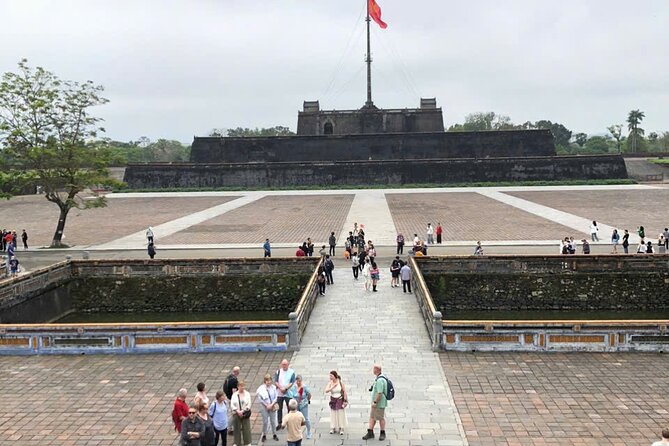
Flag Tower (Kỳ Đài): announcements, festivals, and the public face of the court
Next up is the Flag Tower, a site tied to major events in the Nguyen Dynasty. This is where the imperial center shows itself to the outside world through ceremonies for festivals, celebrations, and public announcements.
It’s a short stop (about 5 minutes), so the value is in the guide’s framing rather than lingering. You’ll likely walk away with a clearer sense of how the court organized “public moments” even while power remained concentrated inside restricted areas.
If you want photos: look for clean angles before you move on, because the tour keeps momentum.


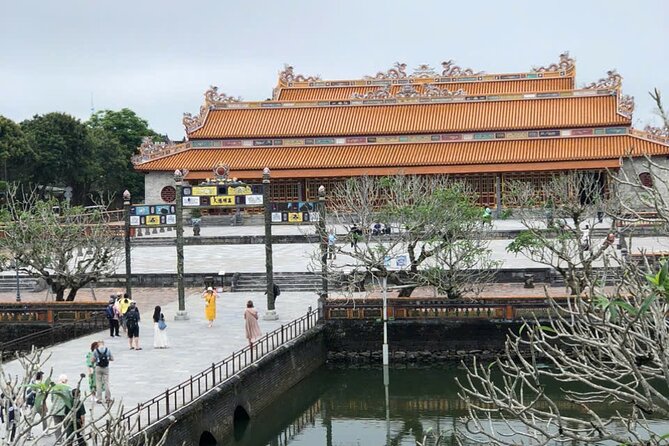
The Noon Gate (Cua Ngo Mon): the emperor’s entrance line
The Noon Gate is the main gate of the Imperial City, and it’s also the one with strong “rules” attached. This gate was reserved for the emperor and his royal entourage, which is why the architecture feels both monumental and controlled.
You’ll spend about 10 minutes here. It’s enough time to get details like layout and positioning, but not so long that you lose the flow. For many people, this is where the tour starts feeling like a guided walkthrough of how authority moved through space.
Thai Hoa Palace: Supreme Harmony and major ceremonies

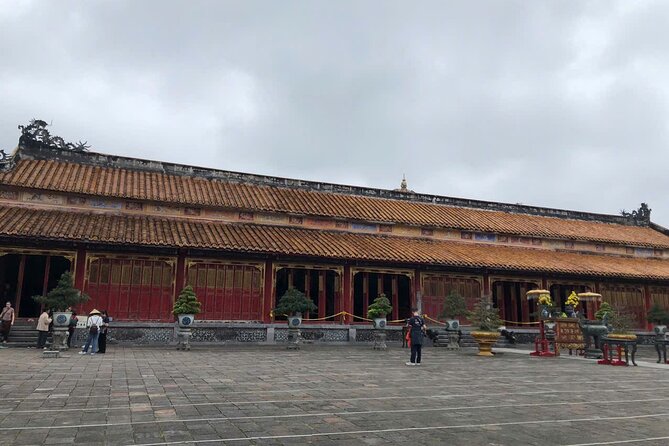
Inside the core palace zone, you visit Thai Hoa Palace, also known as the Palace of Supreme Harmony. This is described as the most important palace within the Imperial City, used for significant imperial ceremonies.
Plan on about 20 minutes at this stop. This is a great moment to slow down, because big palaces can feel “samey” if you’re just scanning rooftops. The guide’s role here is to connect what you’re seeing to what the court did in these rooms, like why certain halls mattered for formal events.
One small consideration: this area can be busier during peak times, so keep moving with the group so you don’t miss the guide’s key explanation.
Nine Dynastic Urns: memory made physical
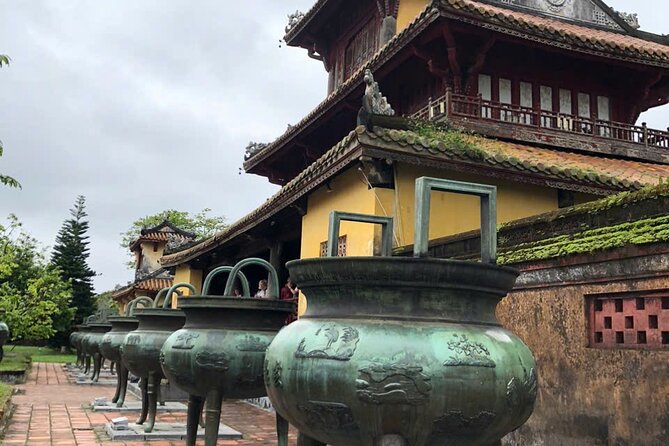
After the main palace, the tour shifts to a different kind of imperial statement: Nine Dynastic Urns. Constructed between 1835 and 1837 under Emperor Minh Mang, these monumental bronze urns are described as about 2.3 meters tall each.
This is another 10-minute stop, but it’s visually distinctive. The urns give you a “human scale” reference for the massiveness of imperial works, even when you don’t measure them yourself. The guide can also help you understand why objects like these were placed and used in royal spaces.
If you’re a details person, this is a stop that rewards attention. If you prefer only the grandest buildings, you might see it as a supporting actor, but it still adds variety to the route.
Thế Miếu (Mieu Temple): worship and the people honored by the court
Next is Thế Miếu, built around 1804, tied to worship for the Nguyen emperors and their queens. The temple also honors great officials connected to the Nguyen Lords’ reign, which broadens the story beyond emperors alone.
You’ll have about 10 minutes here. This stop is valuable because it shows that the citadel was not only about power displays. It was also a place where the court interpreted duty, loyalty, and remembrance through religious and ceremonial spaces.
If you want a more reflective pace, this is a good place to reset your attention for a few minutes.
Inside the Hue Imperial City: the Purple Forbidden City level
The tour then enters Hue Imperial City, including the area often referred to as the Purple Forbidden City. This is where the authority level is described as the highest inside the Imperial City, reserved for the emperor and his royal family.
Expect roughly 15 minutes here. The Forbidden City spaces can be confusing if you’re on your own, because walls, gates, and corridors can look similar. With a guide, you get the sense of hierarchy, like what areas were for restricted access and why the layout matters.
Practical note: save some energy here. This section is often where your shoes will feel the uneven ground and where you’ll appreciate staying with the group.
Kiến Trung Palace: the last chapter of the Nguyen Dynasty
At Kien Trung Palace, you shift from the older imperial core to the late period of the Nguyen Dynasty. Built in 1923 during Emperor Khai Dinh’s reign, it served as the residence of the last two emperors: Khai Dinh and Bao Dai.
You’ll spend about 15 minutes here. This stop gives the tour a sense of time passing. Instead of treating the citadel as a museum set in one year, you see it kept changing as the dynasty changed.
If you like political history and how empires end, this is one of the most emotionally grounded stops in the whole route.
Long Corridor (Trường Lang), Hall of Peace (Thai Binh Lau), and the Theatre
The tour continues with three additional “inside world” stops that help you understand how the court lived and worked beyond big ceremonies.
- Trường Lang (Long Corridor): about 10 minutes, a system of long corridors used to support movement and communication within the palace spaces
- Hall of Peace (Thai Binh Lau): about 10 minutes, described as a tranquil retreat where the emperor could rest, reflect, and compose poetry
- Duyệt Thị Đường Theatre: about 10 minutes, a royal theatre used for cultural performances built during the Nguyen Dynasty
This cluster is valuable because it balances ceremonial authority with day-to-day court culture. Even if you’re not a theatre person, seeing a dedicated performance space helps you understand that “royal life” included art and ritual expression, not only formal proceedings.
Possible drawback: these are shorter stops. If you’re hoping for deep time for photos and details, you may want to do a second self-guided pass afterward, but that depends on your schedule.
Hien Nhơn Gate: finishing at Cửa Hiển Nhơn
The tour ends with Hien Nhơn Gate, located on the eastern side of the Imperial City. Built in 1805 and later renovated under the reigns of Minh Mang and Khai Dinh, it’s described as among the most beautiful parts of the complex.
This stop is about 10 minutes, and it works well as a visual wrap-up. Since you finish at Cửa Hiển Nhơn, you can continue your day without retracing every step back through the same route.
If you’re planning dinner afterward, keep in mind that your next move will depend on what you do next, since the exit gate is different from the start.
Price and value: is 18 USD a fair deal?
At $18.00 per person, this tour sits in the “pay a little to get organized” category. And that’s the key to value here: you’re paying for an English-speaking guide plus a structured pass through major imperial sites.
Many stops list admission ticket included, which helps justify the price if you would otherwise buy entry tickets one by one. Still, the tour also states that all fees and taxes are not included, so it’s smart to be cautious and confirm what you’re covered for when you receive your mobile ticket.
Two more cost realities: transportation to and from the meeting point is not included, and bottled water is not included. Neither of these is a surprise, but they are exactly the kind of small costs that can nudge your day budget if you don’t plan ahead.
For most people, the best way to judge the value is this: will you follow the route anyway on your own? If you want the imperial layout explained in a logical order, the guide and small group size are doing real work.
Comfort and accessibility: walking pace matters here
This tour is listed as suitable for most travelers, and it allows service animals. But the reality is that you’ll be on foot through uneven surfaces and there are uneven steps along the way.
A practical takeaway from the way the tour is described: wear shoes you trust. Think grippy soles and support. If you or someone in your group has limited mobility, you might want to consider a slower plan before committing, because there’s no mention of a step-free route.
If you’re generally active, the walking amount is typically a manageable kind of effort, and the group size keeps the pace from becoming chaotic. If you’re not, you can still do it, just be honest with yourself about stamina.
Smart planning tips that make the day easier
A small amount of prep goes a long way with a citadel walking tour.
- Bring a little cash or card buffer for anything you’re not covered for, since fees and taxes are listed as not included
- Don’t rely on bottled water being there, pack your own
- Use comfortable shoes, because you’ll be doing repeated short stops plus walking between gates and halls
- Have your mobile ticket ready before you reach Cửa Ngăn so you don’t slow the group
Also, since this is commonly booked about 35 days in advance, if your dates are fixed, booking sooner rather than later gives you more choices.
Should you book this Hue Imperial City walking tour?
Book it if you want a guided walk that connects cannons, gates, palaces, temples, and court culture into one understandable route. The strongest reason to choose it is the guide factor: an upbeat, information-heavy explanation tends to make the imperial layout click quickly, even for first-time visitors to Hue’s citadel.
Skip it or choose a different option if stairs and uneven steps are a deal-breaker for you or your group. At $18, it’s also best for people who appreciate structure. If you prefer wandering without an itinerary, you might feel this tour is a bit structured for your taste.
If you do book it, you’ll finish with clear bearings for the rest of your day, because ending at Cửa Hiển Nhơn gives you an exit point that’s easy to plan around.
FAQ
How long is the Hue Imperial City Walking Tour?
The tour lasts about 2 hours 30 minutes.
What is the maximum group size?
The group is limited to a maximum of 12 travelers.
What is included in the price?
An English-speaking guide is included. Admission tickets are listed as included at multiple stops along the route. You also use a mobile ticket.
Where do I meet the guide?
You meet at Cửa Ngăn in Phú Thuận, Tp. Huế, and the guide meets you at the four cannons located at Ngan Gate (Cửa Ngăn).
Where does the tour end?
The tour ends at Cửa Hiển Nhơn on Đoàn Thị Điểm, Thuận Thành, Huế.
Is transportation included?
No. Transportation to and from the meeting point is not included.
Is bottled water included?
No, bottled water is not included.
What is the cancellation policy?
You can cancel for a full refund up to 24 hours before the experience starts, and free cancellation is offered.
If you tell me your travel dates and how mobile your group is, I can suggest a good way to pair this with nearby Hue sights on the same day.
Hue, Citadel and Tombs
- Hue to Hoi An ( Hoi An to Hue) Top Gear with Lefamily Riders Tours ( 1 way)★ 5.0 · 3,156 reviews
- Easy Rider private tour via Hai Van pass from Hue – Da Nang – Hoi An (1Way|Loop)★ 5.0 · 1,542 reviews
- Easy Rider From Hue Da Nang Hoi An Via Hai Van Pass With Mister T★ 5.0 · 769 reviews
- Hue to Dn/Hoi An: Hai Van Pass, beaches & Mt Monkey or vice versa★ 5.0 · 743 reviews
- Hue: Imperial City Walk, Motorbike Tour & Private Car Options★ 5.0 · 732 reviews
Other Hue tours our reviewers keep coming back to
- Hue to Hoi An Jeep Tour via Hai Van Pass
★ 5.0 · 18 reviews - Hue to Hoi An by Private Car with Sightseeing Stops
★ 5.0 · 18 reviews - Private Cycling Tour in Rural Hue with Farming Experience
★ 5.0 · 18 reviews - Hue Dragon Boat Tour: Perfume River, Royal Tombs, Hon Chen Temple
★ 5.0 · 18 reviews - Private Car from Hue to Hoi An With An English Speaking Driver
★ 5.0 · 18 reviews - Exploring Hue Imperial City With Professional Driver By Private Car
★ 5.0 · 18 reviews
Hue Imperial City and Royal Tombs, compared.
 ★ 5.0Hue to Hoi An ( Hoi An to Hue) Top Gear with Lefamily Riders Tours ( 1 way)From $503,156 reviews
 ★ 5.0Easy Rider private tour via Hai Van pass from Hue – Da Nang – Hoi An (1Way|Loop)From $551,542 reviews
 ★ 4.9Hue Customizable Tour with Imperial Citadel & Forbidden CityFrom $12937 reviews
 ★ 4.6Imperial City, Hue: Day Tour from Hoi An and Da NangFrom $47830 reviews
 ★ 5.0Easy Rider From Hue Da Nang Hoi An Via Hai Van Pass With Mister TFrom $58769 reviews
 ★ 4.7Da Nang/Hoi An: Hue Imperial City via Hai Van Pass & LunchFrom $9753 reviews
 ★ 5.0Hue to Dn/Hoi An: Hai Van Pass, beaches & Mt Monkey or vice versaFrom $59743 reviews
 ★ 5.0Hue: Imperial City Walk, Motorbike Tour & Private Car OptionsFrom $7732 reviews
Also in these Vietnam lists