

REVIEW · HUE IMPERIAL CITY AND ROYAL TOMBS
Hue Imperial City Walking Tour 2.5 Hours
Hue’s walls teach you how power worked. This Hue Imperial City walking tour takes about 2.5 to 3 hours and helps you read the whole royal complex, from the Imperial Citadel to the Forbidden City areas. I love how the guide connects Fengshui to real architectural choices, and I also love the human side of history, with court stories that cover emperors, concubines, and eunuchs under the Nguyen Dynasty.
One possible drawback: the entrance ticket to Hue Imperial City is not included, so you need to budget extra on the day. It’s also a walking tour that works best when the weather is decent, so plan to dress for heat and sun.
In This Review
- Key highlights you should know before you go
- Why Hue’s Imperial Citadel feels easier with a guide
- Meeting at Lạc Thiện Restaurant and walking with a small group
- Fengshui and why Hue became the Nguyen capital
- Ngo Mon Gate and the Nine Holy Cannons you can’t ignore
- Royal Family Temple, Royal Library, and the court’s routines
- How royal life worked: emperors, concubines, and eunuchs
- Vietnam War context, and why Hue’s palace story extends beyond the dynasty
- The Nguyen Dynasty timeline, from 1802 to 1945
- Price and entrance fee math, plus value for your day
- Pacing tips for a smooth 2.5 hour walk
- Who this tour fits best
- FAQ
- How long is the Hue Imperial City walking tour?
- What time does the tour start?
- Where is the meeting point?
- What is included in the price?
- Is the Hue Imperial City entrance fee included?
- What is the group size?
- What happens if weather is bad or the minimum number of travelers is not met?
- Final verdict: should you book this Hue Imperial City tour?
Key highlights you should know before you go

- Fengshui made practical, explained in relation to gates, layout, and the capital’s design
- Nguyen Dynasty court stories, with attention to emperors, concubines, and eunuchs
- Big-name monuments you can actually find, including Ngo Mon Gate and Nine Holy Cannons
- A clear “what each part does” walkthrough, so the Forbidden City areas make sense
- A focused, small-group pace, with a maximum of 12 people
More of the citadel and the tombs along the river
- Hue to Hoi An ( Hoi An to Hue) Top Gear with Lefamily Riders Tours ( 1 way)★ 5.0 · 3,156 reviews
- Easy Rider private tour via Hai Van pass from Hue – Da Nang – Hoi An (1Way|Loop)★ 5.0 · 1,542 reviews
- Easy Rider From Hue Da Nang Hoi An Via Hai Van Pass With Mister T★ 5.0 · 769 reviews
- Hue to Dn/Hoi An: Hai Van Pass, beaches & Mt Monkey or vice versa★ 5.0 · 743 reviews
Why Hue’s Imperial Citadel feels easier with a guide

Hue Imperial City can look like a maze if you are just wandering. With a guide steering you through where to look and why it was built, the same walls and courtyards suddenly feel ordered. Instead of just seeing structures, you start understanding the rules behind the space.
What makes this tour worth your time is the way it bundles multiple layers of meaning into one walk. You get the official-style interpretation of the citadel layout, and you also get the lived-in court perspective, including stories about royal life and the people who ran the inner world of the palace. That mix tends to turn a “sightseeing stop” into a story you can remember.
And yes, the monuments are genuinely beautiful. But the guide’s job is to help you notice details that you’d otherwise miss, like how ceremonial spaces line up and how different zones function.
Meeting at Lạc Thiện Restaurant and walking with a small group
You meet at Lạc Thiện Restaurant, 6 Đinh Tiên Hoàng, Phú Hòa, Huế. The tour starts either at 8:30 am or 2:00 pm, and it ends back at the meeting point. Expect to be out for about 2.5 hours of walking time within an overall 3 hours (approx.) experience.
This is a small group tour, capped at 12 travelers, which matters more than it sounds. Smaller groups usually mean fewer distractions, more chance to ask a question, and a tour pace that feels like it was planned rather than rushed. You’ll also be with an English speaking tour guide, which helps when the subject matter is complex.
You’ll also get bottled water (1 per person), which is useful in Hue’s heat. If you’re the type who drinks steadily while walking, you might still want a little extra, since water beyond what’s provided is not included.
Fengshui and why Hue became the Nguyen capital

One of the most interesting promises here is the Fengshui setting explanation, tied to how the Nguyen Dynasty chose Hue. The guide doesn’t just throw out the term and move on. You get the reasons behind the placement and the logic of the setting, the kind of explanation that helps you see the complex as a designed system, not random stone.
Why this matters for you as a visitor: Fengshui is often explained vaguely in tourist settings, and then you forget it five minutes later. On this tour, the guide uses it to explain why particular areas, axes, and major structures exist where they do. When you can connect “plan” to “purpose,” you start reading the citadel the way the people who lived there would have.
The tour also frames the Nguyen Dynasty’s choice of Hue as a real political and cultural decision. That context helps you understand why this place became the center of power, and why the royal architecture reflects that importance.
Ngo Mon Gate and the Nine Holy Cannons you can’t ignore
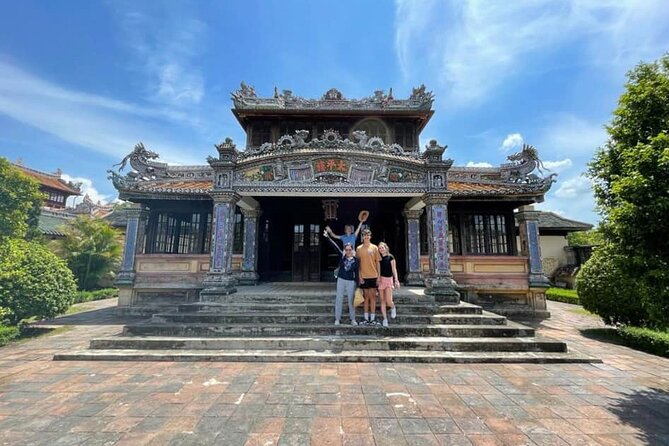
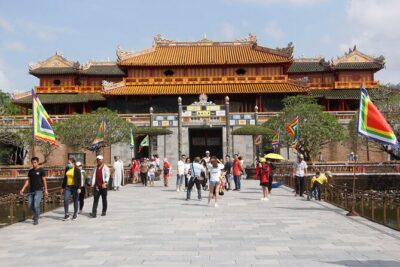
Early in the walk, you’ll cover the citadel’s key zones and ceremonial highlights, including Ngọ Môn Gate. This is one of those places where it’s easy to think, big gate, neat photos. But the guide’s explanations make the gate feel like a turning point, the kind of structure that controlled access and signaled authority.
You’ll also hear about the Nine Holy Cannons. Even if you don’t know what to look for at first, the guide helps you understand why these cannons are part of the complex’s story, not just an added display. It’s the difference between seeing objects and understanding symbolism.
The bigger value in this portion is learning how the complex is organized by function. As you move through the Royal City and Forbidden City areas, the guide points out how each zone fits into court life and ceremony. You end up with a mental map, and that’s what makes the rest of your visit more enjoyable.


Royal Family Temple, Royal Library, and the court’s routines
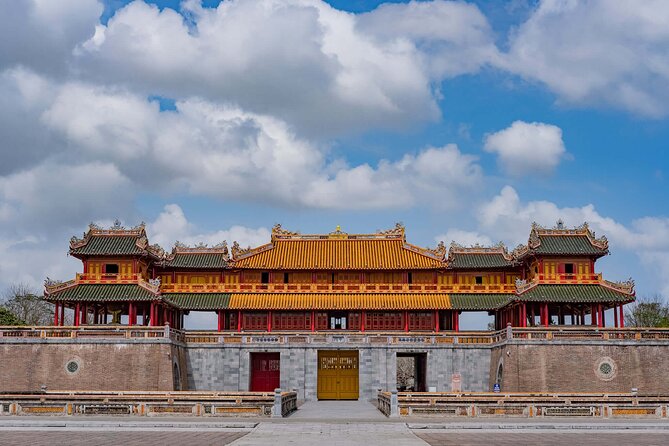
As the tour moves through the Royal City and Forbidden City complex, you’ll see major named sites such as the Royal Family Temple, the Royal Library, and the Royal theater. These are not just “pretty stops.” They relate to roles inside the imperial system, which is where the guide’s storytelling really helps.
The Royal Family Temple, for example, makes you think about continuity and legitimacy, why ancestors and lineage mattered so much. The Royal Library connects to scholarship and recordkeeping as part of ruling. And the Royal theater hints at the cultural side of palace life, where performance and ceremony reinforced order.
You’ll also get explanations about the function of each part of the citadel and what each zone was for. If you’re the kind of traveler who hates vague tours, this is built for you. You’ll leave with a better sense of how power, culture, and daily operations fit together in the palace world.
How royal life worked: emperors, concubines, and eunuchs
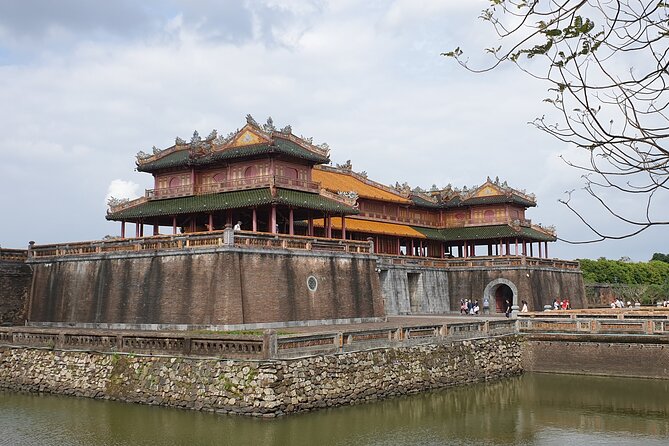
One of the strongest parts of this tour is how it frames royal life through people, not just buildings. The guide shares interesting stories about the royal life of 13 emperors, plus the roles of concubines and eunuchs. That personal angle is what keeps the walk from becoming a dry architecture lecture.
If you worry that palace tours turn into dates and dynastic lists, don’t. This one ties the court’s human structure to the spaces you’re standing in. You start to understand who had access to what, and why certain areas were meant for specific ranks and functions.
The tour also explains main differences between the Nguyen Dynasty and other dynasties you might have heard about in Vietnam and China. That helps you avoid treating imperial history like a single template. The palace becomes a specific system with its own rules.
Vietnam War context, and why Hue’s palace story extends beyond the dynasty
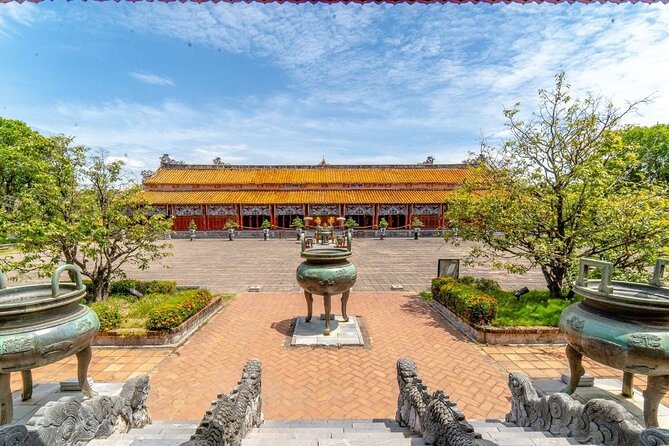
The tour doesn’t stop at the Nguyen era. It also includes lessons about the Vietnam War, framed as part of the broader story around Hue. Even though the walk is focused on the imperial complex, it’s useful to connect the site to later upheavals, because it shows how places survive, change, and get reinterpreted over time.
Why you’ll care: Hue is not just a museum town. It has modern layers, and it’s helpful when your guide gives context that links past and present. You’ll walk away with a better sense that the citadel is connected to larger historical waves, not frozen in time.
If you like history that feels connected rather than separated into neat boxes, this addition can make the tour feel more meaningful without dragging it into unrelated detail.
The Nguyen Dynasty timeline, from 1802 to 1945

A major theme of the tour is the formation and the disintegration of the Nguyen Dynasty from 1802 to 1945. You’ll hear how the dynasty took shape in Hue and what eventually led to its end, and the guide uses that timeline to give meaning to the architecture and court system.
For many visitors, dynasties are just names on a map. Here, the dates help you understand why the palace complex mattered, and why it couldn’t stay untouched by political change. The palace is a system, and when the system changes, the story changes too.
This timeframe also helps you place the imperial city in the lead-up to major 20th-century events. Even if you know only a little about Vietnamese history, the guide’s structure gives you a path through the complexity.
Price and entrance fee math, plus value for your day
The tour price is $27 per person, and it includes bottled water and an English speaking tour guide. The big “do the math” point is the entrance fee: Hue Imperial City admission is listed at ₫200,000 per person and is not included.
So what does that mean for value? You’re paying for guided interpretation for about 2.5 to 3 hours, with a specific focus on the imperial complex’s layout, symbolism, and royal life. If you’re going to visit Hue Imperial City anyway, adding a guide at this price often feels like good spend, because it saves you the guessing game of figuring out what you’re looking at and why.
The entrance fee is separate, but it’s clearly stated. You just need to plan for it so you’re not surprised at the ticket point.
Pacing tips for a smooth 2.5 hour walk
This is a walking tour, so the best way to get value is to arrive ready to move and look. Wear shoes that work on uneven surfaces, and consider light layers since Hue can be warm and bright. Bring sunglasses and sun protection, because you’ll spend time outdoors around major gates and courtyards.
Hydration is partially covered, with one bottled water per person. I’d still recommend you carry a little extra if you tend to drink more than average, since the tour length is short but the pace and sun can add up.
One more practical thought: the experience needs good weather. If rain shows up, expect the tour to be impacted, since weather conditions matter for outdoor walking.
Who this tour fits best
This Hue Imperial City walking tour is especially good if you want your visit to feel structured. You’ll like it if you enjoy explanations of design, symbolism, and how a complex space actually functioned day to day.
It’s also a strong pick if you care about Vietnamese history but want it explained in a way that connects to real places. The tour covers court life, the Nguyen Dynasty’s distinct role, and historical changes up to 1945, plus a Vietnam War context.
If you prefer to roam solo with no guide, you might feel boxed in. But if your goal is to leave with a mental map and clear stories attached to the monuments, a guide-led route is the faster route to understanding.
FAQ
How long is the Hue Imperial City walking tour?
It runs about 2.5 hours, with the overall experience listed as approximately 3 hours.
What time does the tour start?
You can choose a start time at 8:30 am or 2:00 pm.
Where is the meeting point?
The meeting point is Lạc Thiện Restaurant, 6 Đinh Tiên Hoàng, Phú Hòa, Huế, Thành phố Huế, Vietnam.
What is included in the price?
The tour includes an English speaking tour guide and 1 bottled water per person.
Is the Hue Imperial City entrance fee included?
No. The entrance fee is not included and is listed at ₫200,000 per person.
What is the group size?
The tour has a maximum of 12 travelers.
What happens if weather is bad or the minimum number of travelers is not met?
The tour requires good weather. If it is canceled due to poor weather, you will be offered a different date or a full refund. If it is canceled because the minimum number of travelers isn’t met, you will be offered a different experience or a full refund.
Final verdict: should you book this Hue Imperial City tour?
Yes, I think you should book it if your goal is to make sense of Hue Imperial City fast. For a short visit, the Fengshui-focused layout explanations and the court stories about emperors, concubines, and eunuchs do the heavy lifting, so the monuments feel meaningful instead of just scenic. If you’re willing to budget the separate entrance fee, this is a solid way to get more understanding per hour in the complex.
Hue, Citadel and Tombs
- Hue to Hoi An ( Hoi An to Hue) Top Gear with Lefamily Riders Tours ( 1 way)★ 5.0 · 3,156 reviews
- Easy Rider private tour via Hai Van pass from Hue – Da Nang – Hoi An (1Way|Loop)★ 5.0 · 1,542 reviews
- Easy Rider From Hue Da Nang Hoi An Via Hai Van Pass With Mister T★ 5.0 · 769 reviews
- Hue to Dn/Hoi An: Hai Van Pass, beaches & Mt Monkey or vice versa★ 5.0 · 743 reviews
- Hue: Imperial City Walk, Motorbike Tour & Private Car Options★ 5.0 · 732 reviews
Other Hue tours our reviewers keep coming back to
- Hue to Hoi An Jeep Tour via Hai Van Pass
★ 5.0 · 18 reviews - Hue to Hoi An by Private Car with Sightseeing Stops
★ 5.0 · 18 reviews - Private Cycling Tour in Rural Hue with Farming Experience
★ 5.0 · 18 reviews - Hue Dragon Boat Tour: Perfume River, Royal Tombs, Hon Chen Temple
★ 5.0 · 18 reviews - Private Car from Hue to Hoi An With An English Speaking Driver
★ 5.0 · 18 reviews - Exploring Hue Imperial City With Professional Driver By Private Car
★ 5.0 · 18 reviews
Hue Imperial City and Royal Tombs, compared.
 ★ 5.0Hue to Hoi An ( Hoi An to Hue) Top Gear with Lefamily Riders Tours ( 1 way)From $503,156 reviews
 ★ 5.0Easy Rider private tour via Hai Van pass from Hue – Da Nang – Hoi An (1Way|Loop)From $551,542 reviews
 ★ 4.9Hue Customizable Tour with Imperial Citadel & Forbidden CityFrom $12937 reviews
 ★ 4.6Imperial City, Hue: Day Tour from Hoi An and Da NangFrom $47830 reviews
 ★ 5.0Easy Rider From Hue Da Nang Hoi An Via Hai Van Pass With Mister TFrom $58769 reviews
 ★ 4.7Da Nang/Hoi An: Hue Imperial City via Hai Van Pass & LunchFrom $9753 reviews
 ★ 5.0Hue to Dn/Hoi An: Hai Van Pass, beaches & Mt Monkey or vice versaFrom $59743 reviews
 ★ 5.0Hue: Imperial City Walk, Motorbike Tour & Private Car OptionsFrom $7732 reviews
Also in these Vietnam lists